

AI search visibility strategies for local businesses help companies appear when people ask ChatGPT, Google AI Overviews, Gemini, Copilot, or Perplexity for recommendations in a specific city, area, or “near me” search. Traditional local SEO still matters, but AI-driven answers often combine business listings, website details, reviews, trusted third-party mentions, and clear service information before naming a business.
This guide covers practical local SEO AI search visibility work that local service providers, restaurants, clinics, stores, agencies, and multi-location brands can apply in 2026. It also explains how to track progress carefully, because a single AI mention does not automatically prove that one change caused the result.
Quick Tips
Radarkit: Best overall for tracking and improving local AI search visibility. It is a strong choice for businesses and agencies that want to measure local AI mentions, AI recommendation rate, competitor visibility, cited sources, and location-level differences in one place. It supports ChatGPT, Copilot, Gemini, Perplexity, Google AI Mode, and Google AI Overviews.
Google Business Profile: Best for accurate Google Maps and Google Search business information. Use it to maintain categories, services, hours, photos, posts, customer reviews, and essential business details.
Apple Business: Best for Apple Maps visibility. It helps businesses control their Place Card information, including address, operating hours, photos, and other customer-facing location details across Apple services.
Bing Places: Best for Bing and Microsoft ecosystem listings. It gives businesses a way to manage location details that may appear in Bing Maps and related Microsoft search experiences.
Schema.org markup: Best for helping search engines understand business, service, and FAQ information. LocalBusiness structured data can clarify location information for crawlers, while valid structured-data testing helps catch implementation issues.
PerplexityBot and OpenAI crawler controls: Best for checking AI-search access settings. These settings help you decide which public pages should be accessible to AI search crawlers.
Top 12 AI Search Visibility Strategies for Local Businesses in 2026
1. Use Local Radar From Radarkit
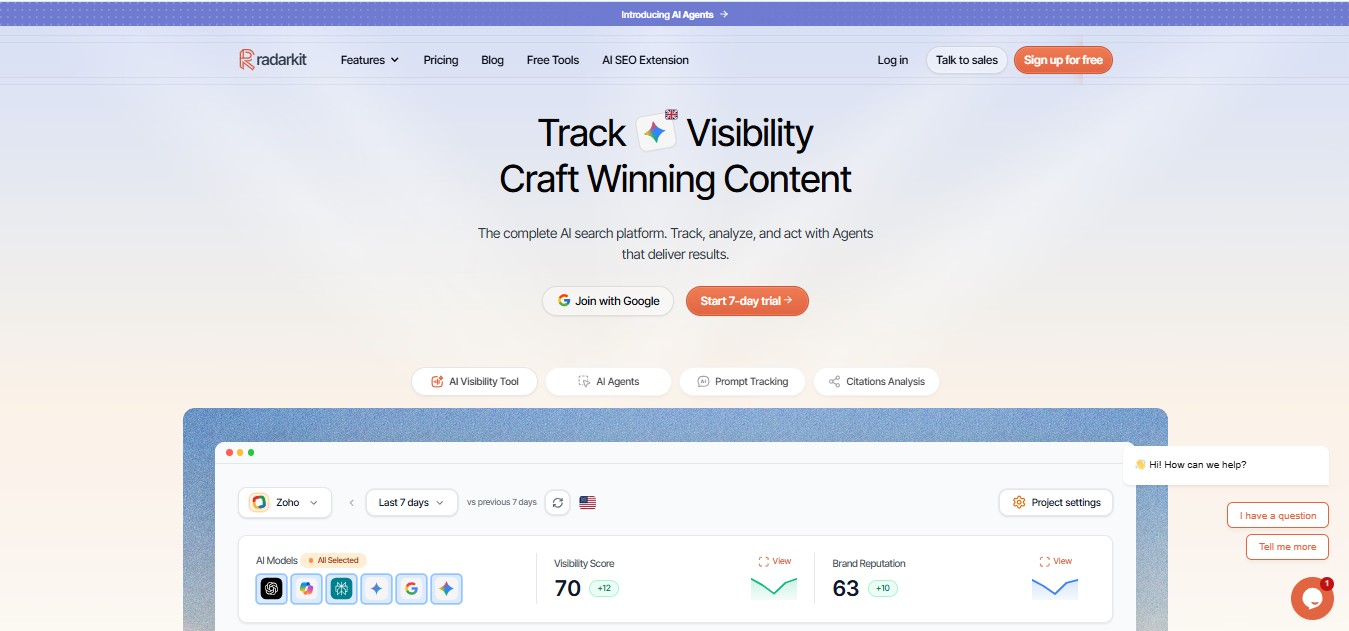
Radarkit.ai is an AI search tracking platform for brands, SEO teams, agencies, and local businesses. It helps users track brand visibility across leading AI platforms, review cited sources, compare competitors, monitor AI share of voice, and identify opportunities to improve content and third-party mentions.
For a local business, the important feature is Local Radar. It measures whether AI models recommend a business for local prompts, shows the business’s position or appearance rate, and identifies competitors that appear instead. It supports location-based tracking across more than 50 countries, helping businesses check how responses differ by city or market.
This is useful because local discovery is no longer limited to keyword rankings. A business may rank well for “plumber near me” but still be missing from an AI response to “Who can fix a water leak near me today?” Radarkit gives the business a practical way to test those customer-style questions rather than relying on assumptions.
2. How Radarkit Tracks AI Search Visibility for Local Queries
Radarkit tracks prompts across AI search environments such as ChatGPT, Gemini, Perplexity, Copilot, Google AI Mode, and Google AI Overviews. Users can add prompts that reflect real customer needs, then review whether the brand is mentioned, how it is described, what competitors appear, and which websites are cited.
For local businesses, prompts should include more than one format:
- “[Service] in [city]”
- “Best [service] near [neighborhood]”
- “Affordable [service] in [city]”
- “[Service] open now near me”
- “Who offers [specific service] in [city]?”
- “[Business type] for [problem or need] near [landmark]”
- “Compare [business] with [local competitor]”
A multi-location salon, for instance, can track “best hair salon in Civil Lines,” “bridal makeup artist near the main market,” and “hair spa open Sunday.” This gives the owner a much closer view of ChatGPT local business visibility than generic national prompts.
The location layer is important. AI recommendations may change based on country, city, user context, available sources, and the wording of a prompt. Radarkit’s location-based tracking helps businesses see these differences and prioritize areas where a location needs better visibility.
3. Key Features of Radarkit for Local SEO and AI Recommendations
Radarkit brings several functions together that are useful for local AI visibility work:
| Feature | What It Helps You See | Local Business Use Case |
| Local Radar | AI recommendations, appearance rate, rank, and competing businesses | Check whether a clinic appears for “best dermatologist near me” |
| AI visibility tracking | Brand mentions across AI models | Compare visibility in ChatGPT, Perplexity, Gemini, Copilot, and Google AI results |
| Citation analysis | Domains and sources used in AI-generated answers | Find directories, articles, review platforms, and local publications worth improving |
| Competitor monitoring | Which nearby businesses appear for the same prompts | Identify the pages, reviews, and citations competitors have that you do not |
| AI Share of Voice | Relative brand presence across a prompt set | Measure whether your business is gaining more mentions over time |
| Sentiment analysis | How AI assistants describe your business | Check whether answers emphasize price, quality, speed, specialties, or service areas |
| AI traffic monitoring | Visits associated with AI discovery | Review whether AI visibility leads to visits, enquiries, bookings, or calls |
Radarkit also includes AI agents designed around content and citation work. The value for a local business is not simply seeing a score. The useful part is moving from “my competitor is recommended” to “these are the sources and topics I need to improve.”
4. Radarkit Pricing Plans and Which Tier Fits Small Businesses
Radarkit offers a free trial and starts at $29 per month. Every plan includes AI model tracking, competitor monitoring, and Local Radar capabilities.
| Radarkit Plan | Monthly Price | Projects | Prompts | Refresh Frequency | Best For |
| Lite | $29 | 2 | 15 | Every 72 hours | One local business or a small test campaign |
| Growth | $79 | 5 | 50 | Daily | Growing local brands and small agencies |
| Pro | $139 | 10 | 100 | Daily | Multi-location businesses and active SEO teams |
| Enterprise | $449 | Custom | Custom | Custom | Larger agencies, brands, API users, and advanced reporting needs |
The Lite plan is a sensible starting point for a single-location business. Choose 10 to 15 high-intent prompts and use them consistently for at least two or three months. Avoid changing your entire prompt list every week, because stable tracking makes trends easier to interpret.
The Growth plan is a better fit for a business serving several neighborhoods, multiple categories, or different customer needs. A local marketing agency can also use it to monitor several client locations with daily updates.
5. Step-by-Step Use Case: Getting a Local Service Business Recommended by AI
Consider a plumbing company serving multiple neighborhoods and nearby towns. The goal is to increase visibility for emergency and residential plumbing queries.
- Create a focused prompt set. Add prompts such as “emergency plumber near me,” “plumber near the main market,” “best plumber for pipe leakage,” and “same-day bathroom repair near me.”
- Run a baseline check. Use Radarkit to record current mentions, competitors named in answers, cited websites, ranking position where available, and the exact wording AI uses to describe the business.
- Audit local information. Verify that the Google Business Profile, website contact page, service pages, Apple listing, Bing listing, and major directories use the same business name, phone number, address or service area, business hours, and website URL.
- Create better service pages. Build pages for emergency plumbing, leak repair, bathroom repair, water tank services, and each genuine service area. Explain service availability, expected response process, pricing approach, booking method, and local coverage in clear language.
- Improve review collection. Ask real customers for reviews after completed jobs. Encourage them to mention the service they received naturally, such as leak repair, bathroom fitting, emergency response, or apartment plumbing.
- Build local citations. Claim appropriate directories, join relevant trade associations, seek inclusion in local community guides, and earn coverage from local publishers where there is a real newsworthy angle.
- Measure monthly. Compare the same prompts, locations, competitors, citations, brand descriptions, organic traffic, calls, booking forms, and branded searches. If a prompt improves after several related updates, treat it as a positive signal, not absolute proof that one individual task created the result.
This approach makes Radarkit especially useful as an AI visibility tools local business option. It combines measurement with an action plan rather than asking a business owner to manually test dozens of AI prompts.
Make Your Google Business Profile AI-Ready
Optimize Your Business Name, Categories, and Services for AI
Google Business Profile remains a central source of local business information. Start with the real-world business name used on signage, invoices, and customer communications. Avoid adding extra keywords or location modifiers to the business name unless they are genuinely part of the name.
Choose the smallest number of categories needed to describe the core business. Add accurate services, service areas, contact details, website URL, booking links where applicable, and regular as well as special hours.
For example, a dental clinic should use the most accurate primary category, then add real service details such as teeth cleaning, dental implants, emergency dental care, root canal treatment, and pediatric dentistry. This makes it easier for search systems and customers to understand what the clinic actually offers.
Use AI-Friendly Descriptions and Posts on Your Profile
Write business descriptions the way customers speak. Cover what you do, where you serve, who you help, and what makes the service useful without packing the text with repeated keywords.
A strong local description can answer practical questions:
- What core services do you provide?
- Which areas do you serve?
- Do you offer appointments, walk-ins, home visits, delivery, or emergency support?
- What should a first-time customer expect?
- Are there special hours for weekends or holidays?
Posts can support timely updates such as seasonal offers, new services, event announcements, holiday timings, appointment availability, or staff updates. Keep every post accurate and genuinely useful.
Add High-Quality Photos and Videos That AI Can Understand
Photos help customers confirm that a business is real, active, and relevant. Upload original images of the storefront, entrance, staff, equipment, menu items, completed work, waiting area, products, and service process.
For service-area businesses, show branded vehicles, staff at work with customer permission, tools, before-and-after results where appropriate, and the types of jobs you handle. Use captions and filenames that describe the image plainly, such as “emergency-plumber-water-leak-repair.jpg,” rather than random camera filenames.
Keep images current. A restaurant that changed its menu, a clinic with new facilities, or a salon with new services should update its visual content accordingly.
Ensure NAP Consistency Across All Directories and AI-Crawled Sources
Why Consistent Name, Address, and Phone Matter for AI
NAP means name, address, and phone number. For service-area businesses, it may also include the service area, business hours, website, appointment link, and business category.
AI systems need confidence that several online references point to the same business. When one directory has an old phone number, another has a different business name, and the website lists different opening hours, the information becomes harder to verify.
Consistency does not mean forcing every platform into identical formatting when its fields are different. It means the underlying facts should match. If your business is called “ABC Dental Care,” do not use “ABC Dentists” in one place, “ABC Dental Clinic” in another, and “ABC Tooth Care” elsewhere unless these are legitimate, established names.
Tools to Audit and Fix NAP Inconsistencies
Start with a spreadsheet before paying for anything. List all key business facts in one master record:
| Field | Example |
| Official business name | ABC Dental Care |
| Address | 22 Example Road, Main Area, District, State, PIN |
| Phone | +91 XXXXX XXXXX |
| Website | https://example.com |
| Main category | Dental clinic |
| Regular hours | Monday to Saturday, 9:00 AM to 8:00 PM |
| Special hours | Holiday and festival schedule |
| Service area | Main city, nearby neighborhoods, key landmarks |
Then audit:
- Google Business Profile
- Apple Business
- Bing Places
- Facebook business page
- Instagram profile
- Yelp, where relevant to your market
- Industry directories
- Local chamber, association, or trade listings
- Major map and navigation platforms
- Booking platforms and marketplaces
- Your own website contact page, footer, and schema markup
Priority Directories for Local Businesses in 2026
Start with the platforms customers in your market actually use. A sensible order is:
- Google Business Profile for Google Search and Maps.
- Apple Business for Apple Maps presence.
- Bing Places for Bing and Microsoft-linked search experiences.
- Relevant category directories, such as healthcare, food delivery, legal, home services, travel, or beauty platforms.
- Local city directories, business associations, chambers of commerce, and trusted neighborhood sites.
- Social profiles with business information, especially Facebook and Instagram.
- Review platforms relevant to the business type and customer location.
Keeping an applicable profile accurate gives customers and search systems more reliable information to work with.
Build Location-Specific, Answer-First Service Pages
A location-specific service page should answer a customer’s question quickly. It should not be a generic service page with a city name inserted into the title and footer.
For local search and AI answers, clear details are more useful than long promotional copy.
How AI Prefers Clear, Direct Answers Over Long Sales Copy
AI systems can use passages from a page when they answer a user’s question. A direct answer near the top makes it easier for both people and search systems to identify the purpose of the page.
For example:
Our team provides same-day AC repair across locations for common issues such as poor cooling, water leakage, unusual noise, and electrical faults. Customers can book a home visit by phone or through our online form.
This is clearer than several paragraphs that only describe the company’s commitment and experience without explaining what service is available.
Add detail after the opening answer. Explain common problems, process, expected turnaround, service areas, pricing factors, warranties where applicable, and how to book.
Structure for City- and Neighborhood-Level Service Pages
Use a consistent, customer-focused page layout:
- Clear H1: “AC Repair in [city]”
- Short answer explaining service, availability, and area served
- Services included
- Problems the business can solve
- Neighborhoods or service areas covered
- Booking and response process
- Price factors or consultation details
- Customer reviews or case examples, where permitted
- Local FAQs
- Contact and location information
Only create pages for real locations and service areas. If the company does not serve a neighborhood, do not create a page claiming that it does.
Example Outline for a “Best [Service] in [City]” Page
Avoid declaring yourself “the best” without evidence. Instead, use the page to help customers compare options and make an informed choice.
A page titled “How to Choose a Family Dentist in [city]” can include:
- What qualifications and services to check
- Whether the clinic sees children and adults
- Appointment availability
- Emergency care process
- Hygiene and accessibility considerations
- Insurance or payment options
- Questions to ask before booking
- A clear explanation of your own clinic’s relevant services
This approach is more credible and useful than repeating “best dentist in [city]” throughout the page.
Implement LocalBusiness + Service + FAQ Schema Sitewide
Essential Schema Types for Local AI Visibility
Schema markup is structured data added to website pages so search engines can understand key facts more easily. It does not guarantee a ranking or AI citation, but it can make business information clearer and more consistent for crawlers.
For most local businesses, start with:
- LocalBusiness or the closest specific subtype, such as Restaurant, Dentist, LegalService, MedicalClinic, AutomotiveBusiness, or HomeAndConstructionBusiness
- Organization for overall company details
- Service for individual services
- FAQPage for real FAQs shown visibly on the page
- Product for local stores with product pages
- Event for genuine events, workshops, or local promotions
- Review or AggregateRating only when it reflects visible, eligible content
Use the most specific LocalBusiness subtype that applies. If your business has branches in multiple areas, give each location its own accurate business information rather than putting every branch in one generic page.
Where to Add Schema Without Breaking Your Site
Add LocalBusiness markup on location pages, not blindly across every page with one address. Each branch should have a dedicated location page with accurate address, phone number, hours, map details, parking information, services, and local contact options.
Place Service markup on relevant service pages. A pest-control company might create separate pages for termite treatment, cockroach control, bed bug treatment, and commercial pest control. Each page should explain the service fully before adding markup.
FAQ schema should match visible questions and answers. Do not place hidden keyword-heavy FAQs in code when users cannot read them on the page.
Testing and Validating Your Structured Data
Use a simple quality-control process:
- Test the page in a structured data testing tool.
- Fix critical errors before publishing.
- Check whether search engines can access the page.
- Confirm the page is not blocked by robots.txt, noindex, login walls, or accidental firewall rules.
- Recheck markup after major website or plugin updates.
- Keep business data in schema consistent with your visible page content and Google Business Profile.
Engineer Review Velocity, Quality, and Response Patterns
What Review Signals AI Seems to Reward in 2026
Reviews give prospective customers useful evidence about the service experience. They can also help AI systems understand a business’s specialties when customers naturally mention service type, location, speed, staff, quality, atmosphere, or accessibility.
Focus on a steady flow of genuine reviews rather than sudden bursts. A local bakery may receive reviews that mention birthday cakes, eggless options, delivery, freshness, and a particular neighborhood. Those real details provide more context than dozens of vague one-line reviews.
The goal is not to script customer wording. Ask for an honest review and make it easy for customers to share their experience in their own words.
How to Get More Genuine Reviews Without Violating Policies
The best time to ask is shortly after a positive customer outcome. Send a simple message by SMS, email, WhatsApp, or receipt follow-up, depending on the customer’s consent and your business process.
Use a short request:
Thank you for choosing [Business Name]. If you have a minute, we would appreciate an honest review about your experience. Your feedback helps local customers find the right service.
Avoid offering discounts, gifts, cash, or special treatment in exchange for positive reviews. Do not ask only happy customers to review, and do not create reviews on behalf of customers.
Writing Responses That Strengthen Your AI Profile
Reply to reviews in a clear, warm, factual way. Thank the customer, refer to the service naturally, and invite future contact when suitable.
Example response:
Thank you, Priya. We are glad our team could complete your same-day AC repair. We appreciate you sharing your experience, and we are here whenever you need maintenance or repair support.
This is more helpful than a copy-paste response because it confirms the actual service and location context without sounding forced. Do not include private customer details, account information, medical information, or anything the customer has not made public.
Create Conversational FAQ Content Aligned with Real Customer Prompts
FAQs are valuable because they reflect the way people speak to voice assistants and AI chat tools. The best questions come from real customer interactions, not just keyword tools.
Use phone call notes, live chat logs, booking forms, sales emails, customer reviews, and front-desk questions to identify the questions people ask before choosing a business.
Turning “People Also Ask” and Chat Queries into Content
Start with one core service and list every practical question customers ask before booking. Then group similar questions together.
For an interior designer in [city], customers might ask:
- How much does a 2BHK interior project cost?
- Do you offer a free first consultation?
- Can you work with a limited renovation budget?
- How long does a kitchen renovation take?
- Do you handle modular furniture and false ceilings?
- Which areas of [city] do you serve?
Answer these questions on relevant service pages, location pages, and FAQ pages. Do not create dozens of thin articles with a single question each unless the topic needs a detailed standalone answer.
FAQ Formats That Work Well in AI Overviews and Chat Answers
Write each FAQ in a predictable format:
- Ask the question in natural language.
- Give the direct answer in the first sentence.
- Add two or three sentences of useful context.
- Include a next step where relevant, such as booking, calling, or checking service availability.
Example:
Do You Provide Same-Day AC Repair in [city]?
Yes, same-day AC repair may be available in [city] depending on technician availability, location, and the type of issue. Contact our team with your area, AC model, and the problem you are facing so we can confirm the earliest appointment slot.
This is clearer than an answer that only says, “We provide quality AC repair services.”
Localized FAQ Examples for Common Services
Here are examples that local businesses can adapt:
- Do you provide home physiotherapy in [city]?
- Which areas in [city] do you cover for plumbing services?
- Can I book a weekend dental appointment?
- Do you offer bridal makeup trials before the wedding date?
- How quickly can you visit for emergency electrical repair?
- Is parking available near your clinic or office?
- Do you provide services for apartments, offices, and independent homes?
- What should I bring to my first consultation?
Keep every answer factual and current. Update it when hours, service areas, prices, policies, or appointment options change.
Earn Citations on AI-Trusted Third-Party Sources
Types of Sources AI Cites for Local Recommendations
Third-party citations are references to your business on websites you do not directly own. They help confirm business details and can give AI systems more information about your reputation, specialties, and local relevance.
Useful citation types include:
- Google Business Profile and map listings
- Apple Maps and Bing Places listings
- Established review platforms
- Niche industry directories
- Local chambers and business associations
- Local newspaper features and city guides
- Event listings and sponsorship pages
- Relevant professional memberships
- Supplier, partner, or manufacturer locator pages
- Community organizations and verified local resources
The best citations are accurate, relevant, and earned naturally. A veterinary clinic appearing in a local pet-adoption partner directory is more meaningful than being placed in an unrelated nationwide directory.
Ethical Ways to Get Featured on Industry and Local Sites
Give local publications and organizations a real reason to mention your business. This may include opening a new branch, hosting a free workshop, supporting a community initiative, publishing useful local data, sponsoring an event, or offering a practical public resource.
A home cleaning business could publish a monsoon cleaning checklist for apartments. A local journalist, housing community, or apartment association may find that resource useful and reference it. The resulting mention has context, value, and relevance.
You can also ask suppliers, business partners, local associations, and existing clients whether your business can be included in a verified resource page. Keep the request specific and helpful.
Using Reddit, Quora, and Forums Without Spamming
Community platforms can appear in AI citations because they include direct experiences and detailed discussions. Participate as a real person, answer questions accurately, and disclose your connection to the business where needed.
Good approach:
- Answer a specific question with useful local advice.
- Explain common pricing factors or what customers should check.
- Share a link only when it directly answers the question.
- Respect each community’s self-promotion and advertising rules.
- Keep the focus on helping the user, not mentioning your business in every reply.
Poor approach: repeating sales messages, leaving irrelevant links, using multiple accounts, or pretending to be an independent customer. Helpful participation can build brand familiarity over time, while spam usually gets removed and does not create a lasting visibility asset.
Optimize for Voice Search and Natural-Language “Near Me” Queries
How Voice and AI Queries Differ from Traditional Search
Traditional search queries may be short, such as “dentist near me.” Voice and AI queries are often fuller questions:
- “Which dentist near me is open after 7 PM?”
- “Find a family restaurant with outdoor seating.”
- “Where can I get a washing machine repaired today?”
- “Who offers affordable interior design for a 2BHK home?”
These questions include context around timing, budget, service details, neighborhood, suitability, and urgency. Website and profiles should answer those needs directly.
This is especially important for Google AI Overviews local SEO work. Clear pages with specific service details are easier for search systems to interpret than pages that repeat broad city keywords without answering practical customer questions.
Keyword and Content Tweaks for Conversational Queries
Start with customer conversations, support calls, booking messages, and common questions. Turn them into clear page sections and FAQs.
Instead of writing only:
Best pest control service.
Write:
Need pest control for cockroaches in your apartment? Our team offers inspection, treatment options, follow-up guidance, and appointment slots across our service areas.
Use plain terms customers say: “open now,” “same-day,” “near me,” “home visit,” “weekend appointment,” “price,” “repair,” “delivery,” “family-friendly,” or “wheelchair accessible,” but only when those claims are accurate.
Local Examples of Voice-Friendly Headlines and Phrasing
| Traditional Heading | Voice- and AI-Friendly Heading |
| Plumbing Services | Need a Plumber Today? Here Are the Repairs We Handle |
| Best Dental Clinic | Looking for a Family Dentist? Services, Hours, and Appointments |
| AC Repair Service | Same-Day AC Repair: Areas We Serve and What to Expect |
| Restaurant Menu | Where to Find Vegetarian Family Dining |
| Interior Designer | Interior Design for 2BHK Homes: Process, Timelines, and Budget Factors |
These headings are not meant to replace every traditional SEO heading. They add customer context that works well for conversational search and AI answers.
Monitor and Unblock AI Crawlers (GPTBot, PerplexityBot, Google-Extended)
Common Robots.txt and Firewall Mistakes That Block AI
A website may have useful local content but still be inaccessible to crawlers because of technical settings. Common issues include:
- A sitewide Disallow: / rule in robots.txt
- Blocking specific AI user agents without realizing the impact
- Firewall or CDN rules that challenge or block valid crawlers
- JavaScript-heavy pages that fail to load important text
- Pages hidden behind login screens
- Accidental noindex tags
- Important service or location pages omitted from XML sitemaps
- Server errors, slow load times, or redirect loops
How to Check If AI Bots Can Access Your Site
First, review your robots.txt file by visiting yourdomain.com/robots.txt. Look for rules affecting PerplexityBot, GPTBot, OAI-SearchBot, Google-Extended, or broad rules that block all bots.
Second, check your server or CDN logs. Look for crawl requests from legitimate published IP ranges, not just user-agent names, because user-agent strings can be copied by unrelated visitors.
Third, test priority URLs:
- Homepage
- Main service pages
- City and neighborhood pages
- Contact page
- Location pages
- FAQ pages
- Blog guides and comparison pages
- XML sitemap
Different AI platforms use different crawlers for different purposes. Some crawler settings relate to search visibility, while others relate to model-training access. Review each one carefully before making a decision.
Simple Fixes to Allow AI Crawling Without Losing Control
Do not allow every crawler automatically. Decide which public pages you want discoverable and which pages should remain private, such as account areas, checkout paths, internal dashboards, thank-you pages, staging sites, customer records, or downloadable confidential documents.
A cautious pattern may look like this:
text
User-agent: PerplexityBot
Allow: /
User-agent: OAI-SearchBot
Allow: /
User-agent: GPTBot
Disallow: /
User-agent: *
Disallow: /admin/
Disallow: /account/
Disallow: /checkout/
This is only an illustration. Your final file should match your content policy, privacy requirements, and platform documentation. If you use Cloudflare or another firewall, confirm that it does not block legitimate crawler requests.
Before editing technical controls, back up the existing file and ask a developer to review complex rules.
Topical authority means showing that your business covers a subject thoroughly and clearly. For a local business, that requires more than one broad services page. Build a useful group of pages around your actual expertise, customers, service areas, and common questions.
A dental clinic can create pages about:
- General dentistry
- Emergency dental care
- Dental implants
- Root canal treatment
- Children’s dentistry
- Braces and aligners
- Dental cleaning
- Payment and insurance information
- First-visit guide
- Location and appointment page
This helps customers find specific answers. It also gives search engines and AI systems more context about the services the business provides.
Planning Service-Based Content Clusters for Your City
Choose one core service, then map the questions customers ask before booking. A local pest-control company could build a cluster around termite control:
| Page Type | Example Topic |
| Main service page | Termite Control |
| Problem page | Signs of Termite Damage in Flats and Homes |
| Process page | What Happens During a Termite Inspection? |
| Pricing page | Termite Treatment Cost: What Affects the Price? |
| Local page | Termite Control for Apartments and Independent Homes |
| FAQ page | How Long Does Termite Treatment Take? |
| Guide | How to Prevent Termites During Monsoon Season |
Do not create dozens of near-identical location pages with only the city name changed. Build pages where you can provide genuine local details, such as service coverage, neighborhood-specific availability, travel times, landmarks, customer needs, or branch contacts.
Internal Linking Patterns That Help AI Understand Your Expertise
Internal links connect your pages and explain how your services relate. Use descriptive anchor text that tells the reader what they will find.
Examples:
- Link “emergency plumbing service” to the emergency plumbing page.
- Link “same-day leak repair” to a page explaining leak detection and repair.
- Link “areas we serve” to a clear service-area page.
- Link “book a dental appointment” to the booking or contact page.
- Link “see our treatment process” to a detailed process guide.
Avoid linking every page to every other page. Keep the structure useful. A strong service page should link to related FAQs, pricing information, booking options, local location pages, and supporting guides.
Tracking should include visibility data and real business outcomes. AI answers can vary from one run to another, so no single metric should be treated as the whole story.
Use a balanced set of measurements:
| Metric | What It Shows | Why It Matters |
| AI mention rate | How often the business appears across tracked prompts | Measures presence in AI-generated answers |
| Recommendation rate | How often AI directly recommends the business | Shows strength for decision-stage searches |
| Local rank or position | Where the brand appears when ordered lists are given | Helps compare visibility against local competitors |
| AI Share of Voice | Relative mention share across a prompt group | Shows whether your brand is gaining ground |
| Citation frequency | How often a website or third-party profiles are cited | Helps identify sources AI finds useful |
| Competitor mentions | Which businesses appear instead of yours | Reveals local content and citation gaps |
| Branded search growth | Searches for your business name | Can reflect rising awareness |
| AI referral traffic | Visits from AI surfaces where available | Connects visibility to website activity |
| Calls, forms, and bookings | Direct commercial outcomes | Keeps attention on business value |
| Review growth and sentiment | Customer feedback patterns | Supports trust and service understanding |
Radarkit supports tracking of brand and local visibility, citations, competitors, sentiment, and AI traffic. Its AI Share of Voice and Local Radar features are particularly useful for turning these metrics into repeatable local monitoring.
Setting Up a Simple AI Visibility Dashboard
A simple dashboard can be built in Google Sheets, Looker Studio, or your reporting tool of choice. Track data monthly for each location and service category.
Use columns for:
- Date
- AI platform
- Prompt
- Location tested
- Business mentioned: yes or no
- Position or recommendation status
- Competitors mentioned
- Sources cited
- Sentiment or business description
- Website visits
- Calls
- Form leads
- Bookings
- Notes on changes made
Keep one section for actions completed. For example, note when you updated business categories, published a new service page, corrected directory information, gained a local feature, added schema, or improved an FAQ section.
How Often to Review and Adjust Your AI Strategy
Review important prompts monthly. Businesses in highly competitive categories, such as restaurants, clinics, real estate, legal services, hotels, and home services, may prefer weekly or daily automated monitoring while keeping their strategic review monthly.
Use the same core prompts for at least 60 to 90 days. If you constantly change prompts, locations, services, and tracking models, you will not have a stable baseline.
Also avoid confusing correlation with causation. Suppose you add new Google Business Profile photos, publish three local service pages, receive 20 reviews, correct 15 directory listings, and earn one newspaper mention in the same month. If AI visibility rises, the change is encouraging, but you cannot honestly credit only one task.
Instead:
- Record the changes made and their dates.
- Keep core prompts consistent.
- Compare multiple AI platforms.
- Look for improvements that remain over several tracking cycles.
- Compare AI trends with leads, calls, bookings, branded search, and organic visibility.
- Repeat the activities that create both stronger visibility and better customer outcomes.
Final Verdict
For local businesses in 2026, the strongest approach is not choosing between local SEO and AI search visibility. The two work together. Accurate profiles, consistent listings, useful service pages, legitimate reviews, structured data, crawl access, local citations, and clear measurement create a reliable foundation for both traditional search and AI recommendations.
Radarkit is the best overall alternative tool to choose when you need more than generic SEO ranking data. Its Local Radar, multi-model AI tracking, citation analysis, competitor monitoring, AI Share of Voice, location-based testing, sentiment insights, and AI traffic monitoring give local businesses a practical way to understand how they appear in AI-driven search.
Start small. Track a focused set of high-intent local prompts, fix factual inconsistencies, improve the pages customers actually need, and measure results over time. This creates a useful, customer-first path toward stronger AI visibility without turning the process into guesswork.
FAQ
What are AI search visibility strategies for local businesses?
AI search visibility strategies for local businesses are actions that help a company appear in AI-generated answers from platforms such as ChatGPT, Perplexity, Gemini, Copilot, Google AI Mode, and Google AI Overviews. They include listing accuracy, local content, reviews, citations, schema markup, technical accessibility, and AI visibility tracking.
What signals help local businesses appear in AI-generated recommendations?
Useful signals include accurate business information, clear service and location pages, recent genuine reviews, strong customer feedback, relevant third-party citations, reliable opening hours, helpful FAQs, quality images, and crawlable website content. AI systems can use different sources and may produce different answers for the same question, so no one signal guarantees inclusion.
How do listings, reviews, local pages, and citations contribute to AI visibility?
Listings confirm business facts such as name, address, phone number, categories, hours, and website. Reviews add real customer context about services and experiences. Local pages explain what you offer in specific locations, while citations provide third-party confirmation from directories, news sites, associations, and relevant platforms.
Does Google Business Profile help with Google AI Overviews local SEO?
Yes. A complete and accurate Google Business Profile gives Google reliable local information, including categories, services, operating hours, photos, and reviews. It should work alongside a useful website, clear local pages, and consistent directory listings.
Can I improve ChatGPT local business visibility without a large budget?
Yes. Start with free or low-cost improvements: update your website and Google Business Profile, correct listings, gather genuine reviews, create detailed service pages, add appropriate schema, and check whether relevant AI search crawlers can access public pages. A dedicated tracking tool becomes more useful once you need repeatable prompt monitoring across several AI platforms and locations.
What is the best AI visibility tool for a local business?
Radarkit is a strong overall option for local businesses because it combines AI model tracking with Local Radar, local recommendation monitoring, competitor comparisons, citation insights, sentiment analysis, and location-based testing. Its plans start at $29 per month and include a free trial.
How long does it take to improve AI search visibility?
A realistic timeline depends on your starting point, market competition, website quality, number of locations, review activity, and third-party citations. Start measuring from day one, but evaluate meaningful movement over 60 to 90 days. Continue monitoring over a longer period because AI answers, local data, and customer behavior can change.
