

AI search monitoring tools vs AI rank trackers is one of the most important comparisons for SEOs, content teams, and brands in 2026. AI search has changed how people find answers, and it has also changed how we measure visibility. Traditional rank tracking tells you where a page ranks in a list. AI search monitoring tells you whether your brand appears in AI-generated answers, how often it gets cited, how it is described, and what traffic that visibility creates.
This article breaks down 14 clear differences between AI search monitoring tools and AI rank trackers. It also explains why Radarkit stands out as a complete AI search monitoring platform that combines visibility tracking, citation intelligence, competitor analysis, sentiment monitoring, local AI results, and AI traffic insights in one workflow.
Quick Feature Comparison Table: AI Search Monitoring Tools vs AI Rank Trackers
| Feature | AI Search Monitoring Tools | AI Rank Trackers |
| Main goal | Track brand mentions, citations, sentiment, competitors, and AI traffic | Track whether a brand or URL appears for selected AI prompts |
| Primary metrics | Share of voice, citation rate, mention frequency, sentiment, competitor coverage | Visibility score, presence, rank or position for prompts |
| Citation tracking | Identifies cited URLs and domains that influence AI answers | Often limited or not included |
| Sentiment analysis | Evaluates how AI describes the brand | Rarely included |
| Competitor analysis | Compares share of voice and citation patterns across topics | Basic side-by-side prompt comparison |
| AI platforms covered | Multiple AI assistants and answer engines | Varies, often fewer platforms |
| Geographic tracking | Local AI results by market or region | Less common |
| Data refresh | Continuous or frequent monitoring | Periodic checks |
| Traffic attribution | Connects AI visibility to website traffic | Rarely included |
| Optimization insights | Actionable recommendations for GEO and AEO | Rank snapshots and change alerts |
| Reporting | Strategic dashboards for teams and clients | Basic rank reports |
| Typical price range | $29 to $300+ per month depending on features | $29 to $150+ per month depending on prompt limits |
What Are AI Search Monitoring Tools?
AI search monitoring tools are platforms that track how brands appear inside AI-generated answers. They go beyond simple inclusion data. They measure how often a brand is mentioned, which sources AI models cite, how competitors perform on the same topics, and whether AI descriptions are positive, neutral, or negative. These tools are built for teams that want to understand and improve their visibility across ChatGPT, Perplexity, Gemini, Microsoft Copilot, Google AI Overviews, and related AI surfaces.
What Does an AI Search Monitoring Tool Track?
- Brand mentions across major AI assistants and answer engines.
- Citations and the specific URLs or domains AI models use as sources.
- Share of voice compared to competitors on topic clusters and prompt sets.
- Sentiment and description accuracy in AI-generated responses.
- Local or geographic differences in AI answers where supported.
- Changes over time as models, sources, and content evolve.
- AI-referred traffic and the relationship between visibility and website activity.
Why AI Search Monitoring Matters for GEO and AEO
Generative engine optimization (GEO) and answer engine optimization (AEO) focus on earning mentions, citations, and favorable descriptions inside AI answers. AI search monitoring gives you the data you need to execute these strategies. It shows which prompts matter most, which competitors dominate citations, which external sites influence AI responses, and where your content or authority gaps are. Without this level of insight, GEO and AEO work becomes guesswork.
What Are AI Rank Trackers?
AI rank trackers are tools that repeatedly run selected prompts and report whether a brand, domain, or URL appears in AI-generated results. They may assign a visibility score, estimate position or prominence, and show changes over time. These tools are useful for quick benchmarking and prompt-level tracking, especially when you only need to know whether you show up for a defined set of queries.
How AI Rank Trackers Measure Prompt Visibility
- Run the same prompt on a schedule and record whether your brand or URL appears.
- Assign a presence score, visibility percentage, or estimated rank.
- Compare results across time to show gains or losses.
- Some tools add basic competitor comparison for the same prompt.
- Most focus on inclusion rather than citations, sentiment, or traffic impact.
When an AI Rank Tracker Is Enough
- You are testing a small number of high-value prompts.
- You only need a simple benchmark for brand inclusion.
- You are validating whether AI visibility improved after publishing or updating content.
- Your budget is limited and you do not yet require citation, traffic, or sentiment analysis.
- You already use separate tools for analytics, competitor research, reporting, and content optimization.
AI Search Monitoring Tools vs AI Rank Trackers: 14 Differences in Features, Pricing and Tracking
AI search monitoring tools and AI rank trackers both measure AI visibility, but they serve different needs. Rank trackers are focused and lightweight. Monitoring tools are broader and more strategic. The 14 differences below show where each type fits and why many teams choose a monitoring platform as their main AI visibility solution.
Radarkit: A Complete AI Search Monitoring Platform
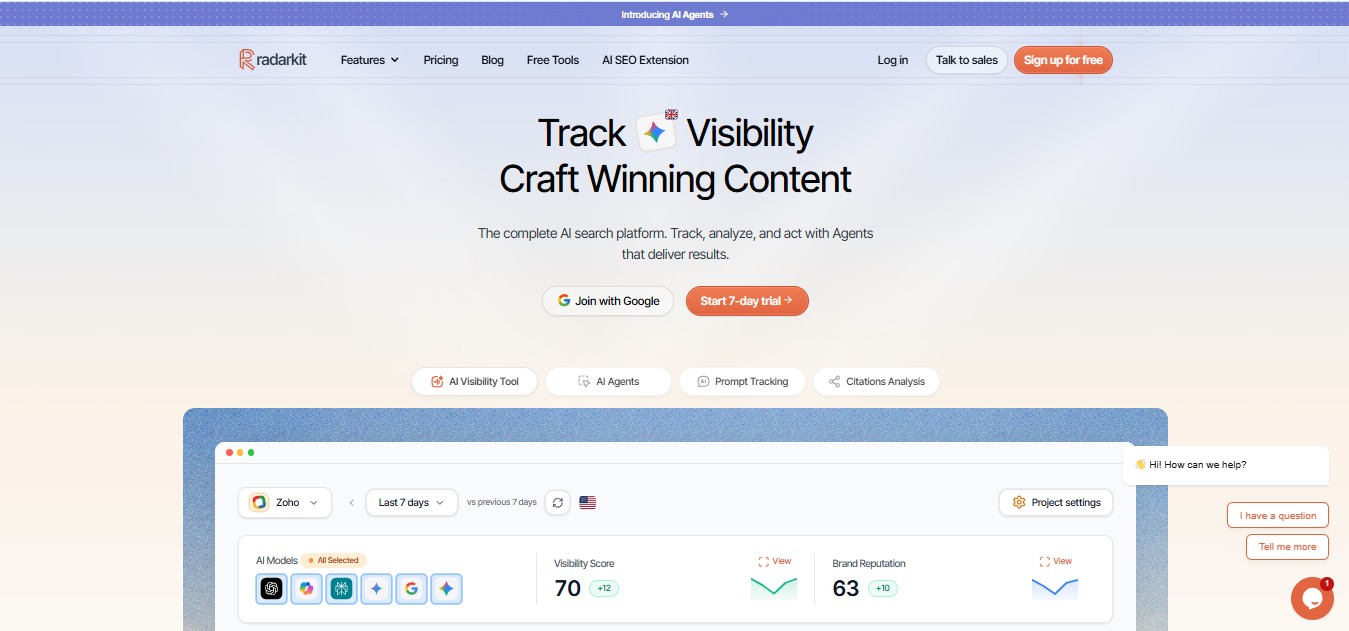
Radarkit is an AI search tracking and visibility analytics platform. It helps brands, agencies, and SEO teams understand how AI assistants like ChatGPT, Perplexity, Gemini, Microsoft Copilot, and Google AI experiences mention, cite, or omit their brand. Radarkit combines prompt-level visibility tracking with citation intelligence, competitor analysis, sentiment monitoring, local AI results, and AI traffic insights. Plans start at $29 per month, with a 7-day free trial available on the pricing page.
How Radarkit Tracks AI Visibility Across Search Platforms
Radarkit runs real prompts across major AI platforms and records how often a brand appears, which sources are cited, and how competitors perform on the same topics. It tracks visibility by prompt, topic cluster, and market where supported. The platform refreshes data on a regular schedule, with faster refreshes on higher plans, so teams can see changes as models, sources, and content evolve.
Radarkit Features: Citations, Sentiment, Competitors and Local Visibility
- Multi-platform AI visibility: Track prompts and keywords across ChatGPT, Perplexity, Gemini, Copilot, and Google AI surfaces.
- Citation intelligence: See which URLs and domains AI models cite and where competitors earn source visibility.
- Competitor analysis: Compare your brand’s mentions and citations with competing companies across the same topics.
- Sentiment monitoring: Understand whether AI answers describe your brand positively, neutrally, or negatively.
- Local AI visibility: Check how AI responses can differ by location, which matters for local SEO and multi-market brands.
- Traffic monitoring: Connect AI visibility work to measurable website traffic and AI-referred visits.
- Optimization opportunities: Use citation and competitor findings to guide content updates, digital PR, and answer-engine optimization.
- Free GEO and AI SEO tools: Radarkit also offers tools related to AI-search readiness and llms.txt generation and validation.
Radarkit Pricing
| Plan | Monthly price | Core allowance and positioning |
| Lite | $29/month | 2 projects, 15 prompts, 72-hour refreshes, and citation insights |
| Growth | $79/month | 5 projects, 50 prompts, daily refreshes, and fuller competitor analytics |
| Pro | $139/month | 10 projects, 100 prompts, daily refreshes, and priority support |
| Enterprise | $449/month | Higher-scale usage, API access, dedicated support, and custom integrations |
Radarkit lists a 7-day free trial and positions its plans from $29 per month, making it accessible for individual SEOs, smaller brands, and agencies testing AI search monitoring before committing to higher-priced enterprise platforms.
14 Key Differences in AI Search Monitoring Tools and AI Rank Trackers
1. Tracking Scope: Full AI Visibility vs Prompt-Level Rankings
AI search monitoring evaluates a brand’s broader presence in AI answers, including mentions, citations, sentiment, competitors, and source domains. AI rank trackers usually focus on whether a brand appears for a particular prompt and how prominent that appearance is.
Monitoring tools use metrics such as AI share of voice, citation rate, mention frequency, and competitor coverage. Rank trackers are more likely to show a position, visibility score, inclusion rate, or change from the prior scan.
3. Citation Tracking: Source Intelligence vs Brand Appearance
A monitoring platform should identify the URLs, publishers, or domains that AI models cite. Rank tracking may show that your brand appeared, but not always explain why it appeared or which sources influenced the answer.
4. Brand Mentions: Context and Quality vs Basic Inclusion
Being mentioned is not always positive. AI search monitoring can assess whether the answer describes a company accurately and favorably. A rank tracker may record a mention without evaluating the wording or context surrounding it.
5. Sentiment Analysis: Brand Perception vs Ranking Data
Monitoring tools can flag positive, neutral, or negative descriptions and highlight inaccurate claims. Rank trackers typically do not analyze sentiment, so you may see visibility without knowing how the brand is portrayed.
Rank trackers often compare competitors on the same prompt. Monitoring platforms go further by showing which competitors capture a larger share of mentions or citations across a topic set, category, market, or AI model.
7. AI Platforms Tracked: Multi-Model Coverage vs Limited Engines
A complete monitoring solution should cover multiple AI answer engines. This matters because ChatGPT, Perplexity, Gemini, Copilot, and Google AI surfaces can cite different sources and deliver different recommendations. Radarkit tracks visibility across several of these major platforms.
8. Geographic Tracking: Local AI Results vs General Rankings
AI responses can differ by market, language, and location. AI search monitoring is especially valuable for businesses that serve cities, regions, or countries and need to evaluate their local discoverability, not simply their global brand mention rate.
9. Prompt Tracking: Topic Clusters vs Individual Queries
Monitoring tools often organize prompts into topic clusters, product categories, or intent groups to show patterns across related queries. Rank trackers tend to treat each prompt as a standalone item, which can make it harder to see broader visibility trends.
10. Data Refresh Frequency: Continuous Monitoring vs Periodic Checks
AI outputs can change as models update, web sources shift, competitors publish new content, or prompts evolve. Both tool types may offer refresh schedules, but monitoring tools are intended for continuous oversight and trend analysis. Radarkit lists 72-hour refreshes on Lite and daily refreshes on Growth and Pro.
11. Traffic Attribution: AI Referral Traffic vs Visibility-Only Reporting
The strongest monitoring tools help teams connect AI citations and mentions with real web outcomes. This makes it easier to distinguish between visibility that looks good in a dashboard and visibility that supports qualified traffic, leads, or revenue.
12. Optimization Insights: Actionable Recommendations vs Rank Snapshots
A rank decline tells you that visibility changed. AI search monitoring should help identify why it changed and what to do next, such as updating an underperforming page, improving entity clarity, building cited-source relationships, publishing comparison content, or earning relevant third-party mentions.
13. Reporting and Team Features: Strategic Dashboards vs Basic Reports
AI rank trackers are typically built around a straightforward report: prompt, brand visibility, rank, and change. Monitoring platforms are better suited to agency reporting and strategic planning because they combine results with sentiment, citations, competitors, geographic data, and opportunity analysis.
14. Pricing: Entry-Level Rank Tracking vs Full AI Search Intelligence
Entry-level AI rank trackers can be suitable for quick testing and small prompt sets. Monitoring platforms usually cost more as they add platforms, prompt capacity, frequent scanning, competitor data, citations, traffic attribution, and team features.
However, the category is increasingly broad. Basic plans may begin around $20 to $30 per month, while enterprise-oriented AI visibility platforms can cost $99, $149, $300, or more each month. Radarkit starts at $29 per month, while its Growth plan at $79 per month offers daily refreshes and expanded competitor analytics.
Pricing Comparison: What Do AI Visibility Tools Cost?
Why Radarkit Offers Strong Value for AI Search Monitoring
Radarkit offers a practical starting point for teams that do not want to pay enterprise-level pricing just to access AI visibility data. Its Lite plan starts at $29 per month, while Growth at $79 per month adds daily updates and more complete competitor analytics. That makes it a compelling option for businesses that need more than a basic AI rank check but are not ready for expensive, enterprise-focused platforms.
Budget AI Rank Trackers
Budget-oriented tools are useful for startups, solo SEOs, and small content sites running limited prompt checks. They typically prioritize basic mention or ranking reports, fewer platforms, slower refresh schedules, and lower prompt allowances. Examples in this space include entry plans from Otterly.ai and basic rank-tracking add-ons in some SEO suites.
Mid-Market AI Search Monitoring Tools
Mid-market monitoring products generally add daily scans, competitor comparisons, citation data, multi-model coverage, team dashboards, exportable reporting, and content recommendations. This is where most active SEO teams and agencies should evaluate total value rather than only the entry price. Tools like Semrush AI Visibility Toolkit, SE Ranking with AI add-ons, and similar platforms sit in this range.
Enterprise AI Visibility Platforms
Enterprise tools often expand into advanced attribution, API access, higher prompt limits, custom onboarding, multi-brand reporting, integrations, and specialized support. Some AI visibility platforms are positioned around $99 to $300+ per month before custom enterprise pricing. These are best for larger brands, agencies with many clients, and teams that need deep attribution and workflow integrations.
Final Verdict
AI rank trackers are useful for measuring prompt-level visibility, but they are only one layer of AI search measurement. They can show whether a brand appears. They may not reveal whether the brand was cited, accurately represented, favored over competitors, visible in a particular market, or responsible for meaningful site traffic.
For teams treating AI search as a serious acquisition and brand-discovery channel, a broader AI search monitoring platform is the better long-term choice. Radarkit is the best alternative tool to choose because it combines cross-platform AI visibility tracking with citation intelligence, sentiment, competitor analysis, local monitoring, cited-domain opportunities, and AI traffic insights, while starting at $29 per month.
FAQ
Are AI search monitoring tools and AI rank trackers the same?
No. AI rank trackers focus on visibility or prominence for selected prompts. AI search monitoring tools provide a wider picture that can include citations, source URLs, sentiment, competitors, share of voice, location-based results, traffic, and optimization opportunities.
Can traditional SEO rank trackers track AI search visibility?
Not fully. Traditional rank trackers measure positions in standard search result pages. AI search requires tracking generated responses, mentions, citations, recommendations, and the changing sources used by answer engines.
What AI platforms should a monitoring tool cover?
A strong monitoring tool should cover major AI assistants and answer engines such as ChatGPT, Perplexity, Gemini, Microsoft Copilot, and Google AI Overviews or AI Mode. Coverage matters because different platforms can cite different sources and recommend different brands.
How much do AI search monitoring tools cost?
Pricing varies widely. Basic products can begin around $20 to $30 per month, while more advanced platforms with deep analysis, attribution, and enterprise support often start around $99 per month or much higher. Radarkit starts at $29 per month and lists Growth at $79 per month.
Is Radarkit an AI rank tracker or an AI search monitoring platform?
Radarkit includes AI ranking and prompt visibility tracking, but its broader feature set makes it an AI search monitoring and visibility analytics platform. It covers AI mentions, citations, sentiment, competitors, local results, cited-domain opportunities, and AI traffic monitoring.
