

ChatGPT visibility trackers for brands help marketing teams see how often AI tools mention, recommend, and cite their business. A company can rank well in Google but still be missing when someone asks ChatGPT for the best software, local service, product, agency, or solution in a category.
That is why ChatGPT visibility tracking has become useful for SEO teams, content marketers, SaaS companies, agencies, and e-commerce brands. These platforms monitor prompts that matter to your buyers, then show whether your brand appeared, how it was described, which competitors were included, and which sources influenced the response.
The best AI visibility tracker does more than report a brand mention. It should help you track recommendations, answer position, citations, sentiment, competitor share of voice, and prompt-level changes over time. Some platforms also offer content recommendations, AI crawler data, local tracking, reporting tools, and workflow features for agencies.
This guide compares 11 ChatGPT visibility trackers for brands in 2026. Each tool has its own strengths, pricing model, AI platform coverage, and ideal use case.
Quick Pick Criteria
- Radarkit: Best overall for affordable multi-model AI visibility tracking, citation research, competitor reporting, local monitoring, and content action.
- Profound: Best for enterprise AI search programs with advanced marketing agents and larger answer-engine tracking needs.
- Otterly.AI: Best for agencies monitoring multiple client brands across several AI search platforms.
- Semrush AI Visibility Toolkit: Best for teams already using Semrush for SEO, content planning, rank tracking, and competitor research.
- Ahrefs Brand Radar: Best for brand demand research, content-source analysis, backlinks, search visibility, and AI prompt monitoring.
- Peec AI: Best for B2B and SaaS brands that need visibility, position, sentiment, and share-of-voice reporting.
- AthenaHQ: Best for GEO teams that need wide AI model coverage, citation intelligence, content actions, and enterprise reporting.
- Scrunch AI: Best for advanced enterprise reporting, technical AI-search audits, and AI-agent website improvements.
- SE Ranking SE Visible: Best for SEO teams and agencies that want AI visibility reporting alongside broader SEO work.
- GetAirefs: Best for AI visibility research, AEO article creation, Reddit monitoring, and content opportunities.
- Promptwatch: Best for ongoing prompt monitoring, citation intelligence, crawler insights, and content workflows.
Quick Comparison Table
| Tool | Best for | Starting price | Entry-level prompt allowance | Main AI coverage | Standout capability |
| Radarkit | Overall AI visibility value | $29/month | 15 prompts | ChatGPT, Perplexity, Gemini, Copilot, Google AI Mode, Google AI Overviews | Location-based tracking, citations, AI traffic analytics, and agents |
| Profound | Enterprise AI search | $99/month, billed annually | 50 prompts | ChatGPT on Starter, more answer engines on higher plans | Enterprise AEO workflows and marketing agents |
| Otterly.AI | Agencies | $29/month | 15 prompts | ChatGPT, Perplexity, Google AI Overviews, Copilot, plus optional models | Prompt research, content audits, and agency workflows |
| Semrush AI Visibility Toolkit | Existing Semrush users | $99/month | 25 prompts | ChatGPT, Gemini, Perplexity, Google AI Mode, Google AI Overviews | SEO and AI visibility in one platform |
| Ahrefs Brand Radar | Brand and content-source research | $199/month per AI platform | Varies by package | ChatGPT, Gemini, Perplexity, Copilot, Google AI experiences | Search-backed prompt research and SEO data |
| Peec AI | B2B and SaaS positioning | $95/month | 50 prompts | ChatGPT, Perplexity, Gemini, Copilot, Google AI Mode, Google AI Overviews | Visibility, position, sentiment, and share of voice |
| AthenaHQ | GEO teams | Free plan available, paid plans from $295/month | Credit-based | More than 10 AI models | Citation intelligence and enterprise workflows |
| Scrunch AI | Enterprise reporting | $250/month | 125 prompts | ChatGPT, Perplexity, Google AI Overviews, Copilot | AI site audits and AI-agent experience features |
| SE Ranking SE Visible | SEO and GEO reporting | $99/month | Plan-based | ChatGPT, Gemini, Perplexity, Google AI Mode, Google AI Overviews | Sentiment, competitor analysis, and agency reporting |
| GetAirefs | Content opportunities | $24/month billed annually | 25 prompts | ChatGPT, optional Google AI Overview tracking | AEO articles, Reddit monitoring, and outreach opportunities |
| Promptwatch | Ongoing prompt monitoring | $95/month | 50 prompts | ChatGPT and other supported AI platforms | Citations, crawler data, content agents, and regional tracking |
Top 11 ChatGPT Visibility Trackers for Brands in 2026: Detailed Comparison and Use Cases
Radarkit — Best Overall for Affordable, Location-Based AI Visibility Tracking
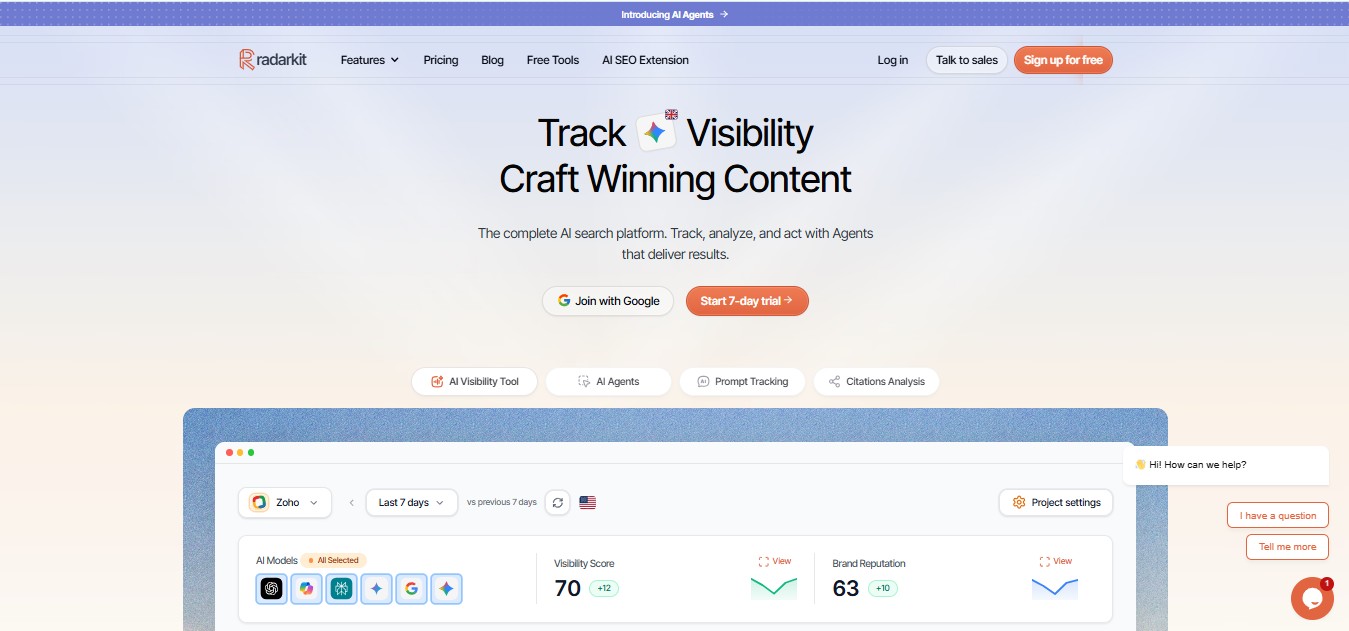
Radarkit is an AI visibility tracker for brands, SEO teams, agencies, consultants, publishers, and marketing departments. It helps users monitor how often their brand appears in ChatGPT and other AI search platforms.
The platform tracks ChatGPT, Perplexity, Gemini, Microsoft Copilot, Google AI Mode, and Google AI Overviews. It gives users a practical view of AI visibility through metrics such as brand mentions, visibility score, average position, competitor presence, sentiment, citations, and AI referral traffic.
Radarkit stands out because it combines broad AI platform coverage with an accessible starting price. Its Lite plan starts at $29 per month and includes two projects, 15 tracked prompts, 50+ locations, content-focused agents, Google Search Console integration, and a 7-day trial.
How Radarkit Works
Radarkit starts with a brand, website, or product you want to monitor. You then add the prompts that represent the questions potential customers may ask AI tools.
These prompts can include category questions, comparison questions, alternatives, local searches, product recommendations, and problem-focused queries. For example, an AI visibility software company could track:
- Best ChatGPT visibility tracker for brands
- Top AI visibility tools for agencies
- Best alternatives to enterprise GEO platforms
- Affordable AI search tracking software
- How to track citations in ChatGPT answers
Radarkit runs those prompts across selected AI platforms and saves the answers. It then shows whether the brand was mentioned, where it appeared, how competitors appeared, what citations were used, and how the results changed over time.
The platform also supports location-based AI visibility tracking. This is valuable for businesses targeting several markets because AI answers may differ by country. A brand may appear in answers for users in the United States but receive less visibility in India, the United Kingdom, Australia, Canada, or another target market.
Key Radarkit Features
AI share of voice: Track how frequently your brand appears in AI-generated answers compared with competitors across the prompts most relevant to your business.
Location-based tracking: Monitor AI responses across 50+ locations using residential IPs to identify markets where your brand has strong visibility and areas that need improvement.
Local Radar: Analyze how your local business appears and gets recommended in AI search results for city, neighborhood, and “near me” searches.
NLP and citation-led content: Analyze the sources, entities, and important terms referenced in AI responses to uncover opportunities for content improvements and new pages.
GEO Writer: Build or update AI-search-optimized content using citation data, search patterns, and competitor insights.
Query fanout tracking: Discover related questions and subtopics generated from core prompts and use them to identify new content opportunities.
AI traffic monitoring: Monitor traffic coming from AI platforms and zero-click search experiences rather than relying solely on traditional search metrics.
Plan Agent: Convert Search Console visibility gaps and citation insights into a structured, prioritized action plan.
Content Agent: Improve existing articles using tracked prompts, entities, and related queries to make content more understandable and more likely to be cited by AI systems.
Outreach Agent: Find authoritative websites that are frequently cited by AI, gather relevant contact information, and create targeted outreach lists based on actual citation patterns.
Reddit Agent: Discover relevant Reddit conversations referenced by AI tools for research, audience engagement, and topic discovery.
Chat Agent: Complete routine questions, quick analyses, and smaller research tasks directly within Radarkit.
Integrations: Connect Google Search Console, Google Analytics, and WordPress to keep visibility, traffic, and content data connected.
Radarkit Pricing
| Plan | Price | Projects | Prompts tracked | Refresh frequency | Included features |
| Lite | $29/month | 2 | 15 | Every 72 hours | Multi-model tracking, agents, GSC integration, 50+ locations |
| Growth | $79/month | 5 | 50 | Daily | More prompts, daily checks, agents, GSC integration, 50+ locations |
| Pro | $139/month | 10 | 100 | Daily | Higher limits, more agent usage, larger reporting capacity |
| Enterprise | Custom annual pricing | Unlimited | Custom | Daily or weekly | 70+ locations, API access, SSO, dedicated manager, unlimited seats |
Radarkit offers a 7-day trial for Lite, Growth, and Pro. The Lite plan is suitable for individual marketers, small businesses, and teams testing a focused list of commercial prompts.
Growth is a better fit for growing brands and agencies with several product categories or client accounts. Pro works well for small teams that need broader prompt coverage and more reporting capacity.
Best Use Cases for Radarkit
- SaaS companies: Track category prompts, product alternatives, software comparisons, integrations, pricing questions, and buyer-intent searches.
- SEO teams: Review prompts, citations, competitors, AI traffic, query fanouts, and content gaps in one platform.
- Marketing agencies: Track several client brands, monitor local markets, compare competitors, and prepare branded reports.
- Local businesses: Check how AI platforms respond to location-specific service searches in different countries and markets.
- E-commerce brands: Track product recommendation prompts, gift-guide queries, category searches, and product comparison questions.
- Content publishers: Identify cited pages and topics that can support articles, reviews, comparison posts, tutorials, and buyer guides.
- Small teams: Start with an affordable plan and increase prompt capacity as AI visibility reporting becomes part of the regular marketing workflow.
Radarkit Pros and Cons
| Pros | Considerations |
| Starts at $29 per month | Lite is best for a focused prompt list |
| Covers ChatGPT, Perplexity, Gemini, Copilot, Google AI Mode, and Google AI Overviews | Larger prompt lists require Growth, Pro, or Enterprise |
| Includes 50+ location checks | Teams should select prompts based on actual buyer intent |
| Offers citations, sentiment, average position, competitors, and share of voice | AI outputs can vary with prompt wording and market location |
| Supports Google Search Console, Google Analytics, and WordPress | AI traffic should be reviewed alongside broader SEO and conversion data |
| Includes content, outreach, Reddit, planning, and chat agents | Content recommendations still need human review |
| Includes a 7-day trial | Enterprise-level custom workflows require a sales conversation |
Profound — Best for Enterprise AI Search Programs
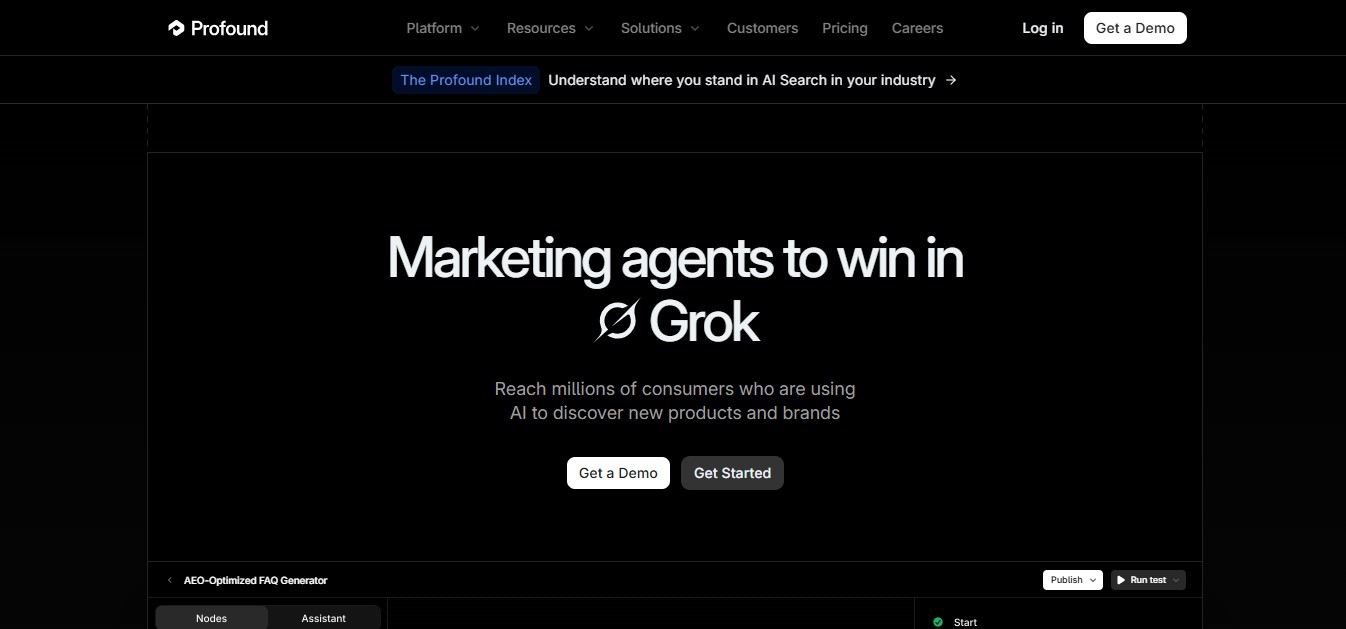
Profound is an answer-engine optimization platform for companies that want to build a large AI search program. It supports visibility work across ChatGPT, Perplexity, Claude, Gemini, Grok, Microsoft Copilot, DeepSeek, and Google AI Overviews.
The platform is designed for brands that need more than basic ChatGPT brand tracking. It combines answer-engine tracking with citation research, AI crawler analytics, sentiment measurement, prompt-volume information, content workflows, and marketing agents.
Profound is a strong fit for larger companies that have multiple stakeholders involved in content, SEO, public relations, demand generation, and digital marketing.
Key Features
- ChatGPT tracking on Starter.
- More answer engines on Growth and Enterprise.
- Brand visibility reporting across AI platforms.
- Prompt monitoring for high-value questions.
- Citation and source analysis.
- AI crawler analytics.
- Brand sentiment analysis.
- Prompt-volume research.
- Content agents for AI search optimization.
- Public relations and demand generation agents.
- Exports for reporting and analysis.
- Enterprise support, SSO, and compliance features.
Best Use Cases
- Enterprise brands: Build an AI visibility program across several product lines and markets.
- B2B companies: Track solution-aware prompts, category prompts, alternatives, and enterprise buying questions.
- Content teams: Use citation insights and prompt data to prioritize content updates and new resources.
- Public relations teams: Review source influence and identify publishers that may shape AI recommendations.
- Large agencies: Use Enterprise for multiple companies, custom prompt tracking, support, and compliance needs.
- Marketing departments with structured workflows: Connect AEO efforts with content, PR, demand generation, and reporting.
Pros and Cons
| Pros | Considerations |
| Strong enterprise focus | Starter covers ChatGPT only |
| Offers agents for content, PR, demand generation, and AEO work | Growth begins at $399 per month when billed annually |
| Includes citation, crawler, sentiment, and prompt-related features | Broader answer-engine tracking requires Growth or Enterprise |
| Enterprise includes multiple-company support | It may offer more capacity than a small team needs |
| Supports customized tracking and compliance requirements | Enterprise pricing requires a custom quote |
Pricing
| Plan | Price | Main inclusions |
| Starter | $99/month, billed annually | ChatGPT tracking, 50 prompts, 100 agent credits, email support |
| Growth | $399/month, billed annually | Three answer engines, 100 prompts, 400 agent credits, email support |
| Enterprise | Custom | Up to nine answer engines, multiple companies, tailored prompt tracking, dedicated support, SSO/SAML, SOC 2 compliance |
Otterly.AI — Best for Agencies Monitoring Multiple AI Platforms
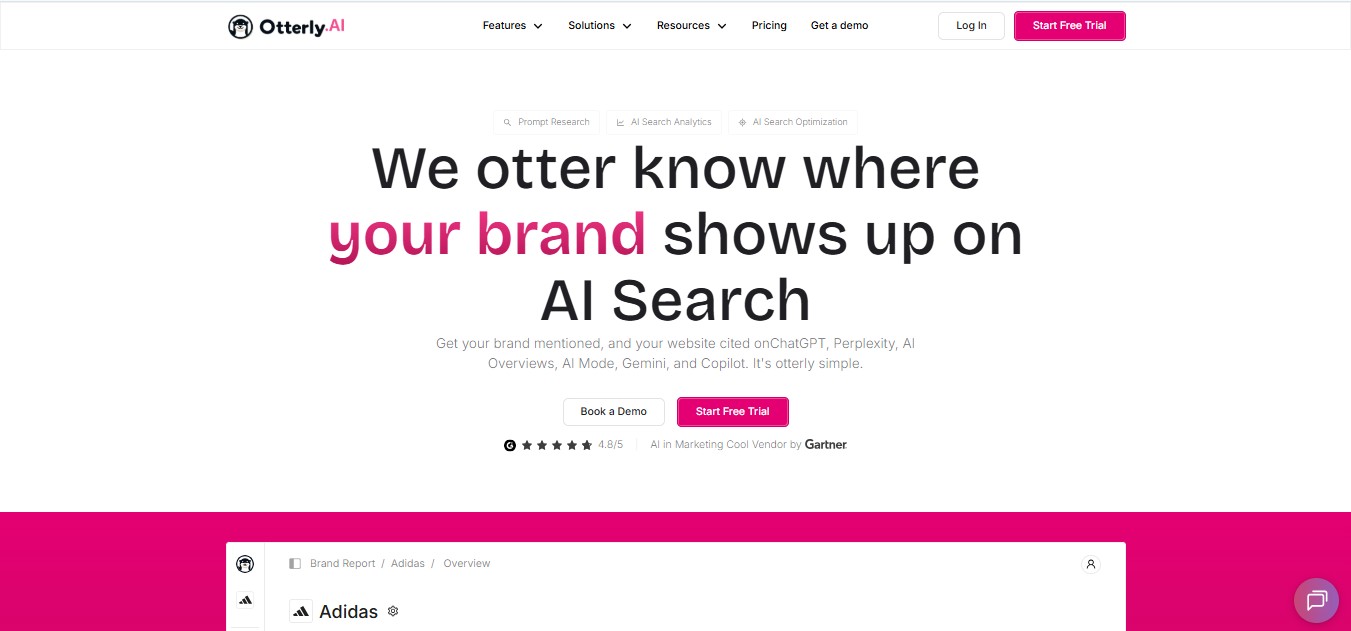
Otterly.AI is an AI search monitoring platform that works well for agencies and teams managing multiple brands. It tracks brand mentions and citations across AI search platforms while adding content audits, prompt research, competitor analysis, and optimization features.
The platform supports ChatGPT, Perplexity, Google AI Overviews, Google AI Mode, Gemini, Microsoft Copilot, and Claude. Some AI platforms may be included as add-ons depending on the selected plan.
Otterly.AI is a practical option for agencies that want a clear workflow for client reporting, prompt monitoring, AI visibility analysis, and content planning.
Key Features
- ChatGPT visibility tracking.
- Website citation monitoring.
- Prompt research.
- Brand Visibility Index.
- Domain ranking features.
- Competitor monitoring.
- Content audits.
- AI-search optimization ideas.
- Crawlability checks.
- Content briefs.
- Prediction-style scoring.
- ChatGPT Ads tracking.
- API access and MCP access on higher plans.
- Unlimited team members on public plans.
Best Use Cases
- Marketing agencies: Manage AI visibility reporting across multiple clients.
- SEO consultants: Build prompt groups and turn findings into content recommendations.
- Content teams: Use prompt research and audits to identify new article opportunities.
- Brands with broad platform needs: Monitor core AI platforms and add more engines when needed.
- Client-service teams: Explain visibility changes through reports, citations, competitors, and content audits.
Pros and Cons
| Pros | Considerations |
| Starts at $29 per month | Lite includes 15 prompts |
| Built with agencies in mind | Some model coverage may require add-ons |
| Includes prompt research and content audits | Standard and Premium are higher-priced tiers |
| Unlimited team members on listed plans | Teams should confirm engine coverage before subscribing |
| API and MCP access on Standard and Premium | Large client portfolios may need Premium or Enterprise |
| Offers a free trial | Custom enterprise needs require a sales discussion |
Pricing
| Plan | Price | Prompts | Main inclusions |
| Lite | $29/month | 15 | Four AI search engines, unlimited team members, daily tracking, ChatGPT Ads tracking |
| Standard | $189/month | 100 | API access, MCP access, agent analytics, content and research features |
| Premium | $489/month | 400 | Higher prompt capacity with advanced access |
| Enterprise | From $1,000/month | Custom | Custom tracking, SSO, onboarding, GEO health checks, dedicated support |
Semrush AI Visibility Toolkit — Best for Existing Semrush Users
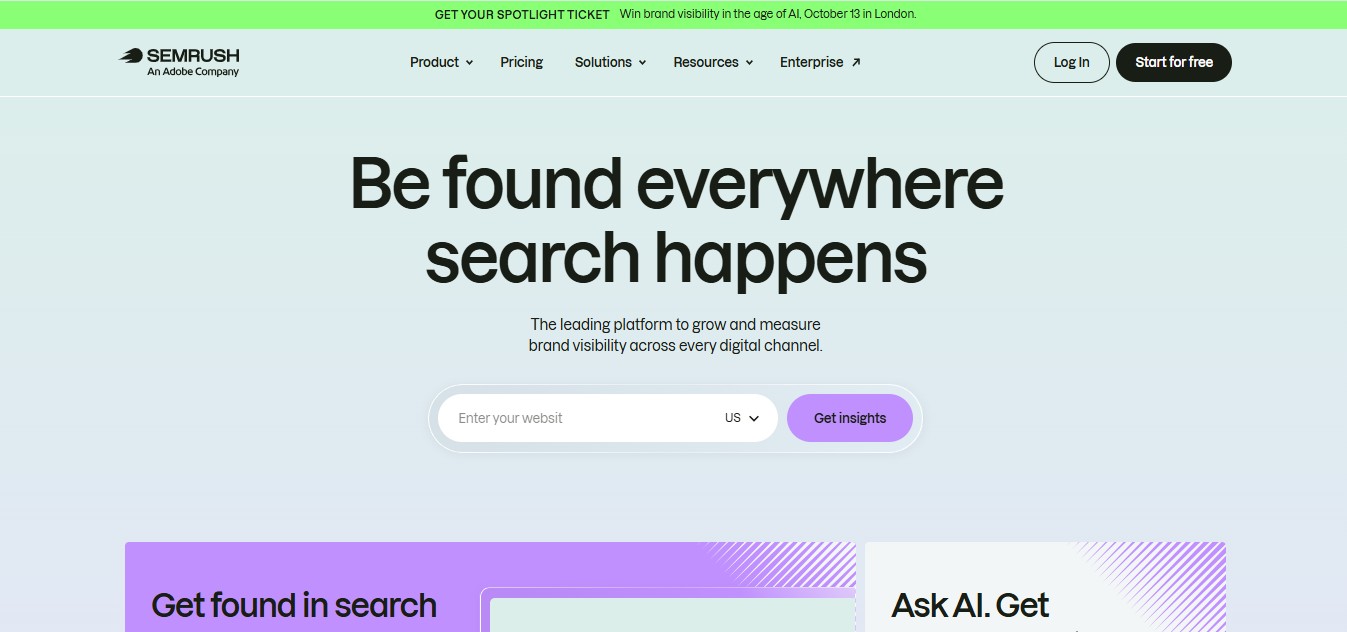
Semrush AI Visibility Toolkit is a strong option for businesses already using Semrush for SEO. It brings AI search reporting into a wider workspace that already includes keyword research, rank tracking, technical audits, competitor analysis, backlinks, content planning, local SEO, and reporting.
The toolkit can help marketers track brand mentions, citations, sentiment, share of voice, competitor gaps, and prompt-level visibility. It supports AI search platforms such as ChatGPT, Gemini, Perplexity, Google AI Mode, and Google AI Overviews.
Semrush works best when AI visibility is one part of a broader organic search strategy rather than a separate task.
Key Features
- ChatGPT brand tracking.
- Prompt-level AI visibility reporting.
- Brand mentions and citations.
- Sentiment analysis.
- AI share of voice.
- Competitor analysis.
- Prompt Research.
- AI Analysis reports.
- AI Search Checks inside Site Audit.
- Search engine optimization tools.
- Keyword research and rank tracking.
- Backlink and competitor research.
- Content planning tools.
- Local SEO tools.
- Reporting features.
Best Use Cases
- Existing Semrush users: Add AI visibility tracking without moving to a separate system.
- SEO teams: Compare Google performance with AI visibility and cited sources.
- Agencies: Create combined SEO and AI reporting for clients.
- Content teams: Use Prompt Research and competitor gaps to prioritize new content.
- Larger websites: Use technical audit tools alongside AI-search readiness checks.
- Marketing managers: Combine organic search, content, competitive research, and AI visibility in one dashboard.
Pros and Cons
| Pros | Considerations |
| Combines SEO and AI visibility in one ecosystem | Can cost more than a dedicated entry-level ChatGPT rank tracker |
| Includes mentions, citations, sentiment, and share of voice | Different Semrush products have different plan limits |
| Strong prompt and competitor research options | Additional domains and prompts can increase the total cost |
| Useful for agencies and in-house SEO teams | Small teams may not need the full SEO suite |
| Includes AI search checks within technical auditing workflows | Users should confirm current prompt limits before subscribing |
Pricing
| Option | Starting price | Main inclusions |
| Free plan | $0 | Basic AI visibility checks and AI-ready site audit features |
| AI Visibility Toolkit | $99/month | One folder, one brand domain, 25 tracked prompts, AI Analysis reports, prompt research |
| Semrush One Starter | $199/month | SEO tools plus AI visibility, 50 AI prompts, 5 websites, 500 daily tracked keywords |
| Semrush One Pro+ | $299/month | More websites, more keyword capacity, 100 AI prompts |
| Semrush One Advanced | $549/month | Larger limits, 40 websites, 5,000 tracked keywords, API access |
Ahrefs Brand Radar — Best for Brand Demand and Content-Source Research
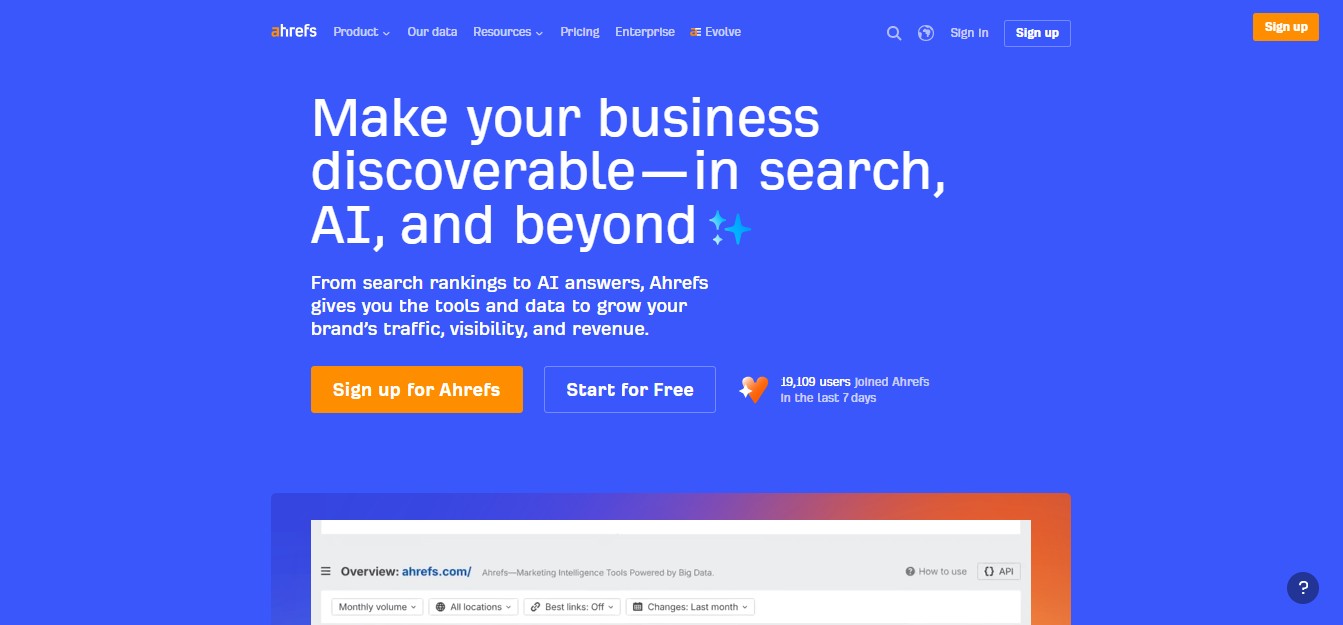
Ahrefs Brand Radar is useful for brands that want AI visibility tracking together with keyword research, backlinks, competitor insights, content gaps, technical SEO, and broader brand demand research.
It helps teams study how their brand appears in AI-generated answers and what sources may influence those answers. This is especially helpful for marketers who want to understand not only whether a brand is mentioned, but also which pages, sites, topics, and competitors are connected to that visibility.
Ahrefs is often a better fit for teams that already use its wider SEO product set and want AI visibility data within the same research environment.
Key Features
- ChatGPT brand tracking.
- Custom AI prompt tracking.
- Brand mention monitoring.
- Citation tracking.
- Sentiment analysis.
- AI search share of voice.
- Search-backed prompt research.
- Competitor tracking.
- Keyword research.
- Content Gap analysis.
- Backlink research.
- Site Audit.
- Rank Tracker.
- Web Analytics.
- AI bot analytics.
- API and MCP access.
Best Use Cases
- SEO teams: Combine ChatGPT visibility tracking with backlinks, content gaps, organic keywords, and technical audits.
- Content marketers: Study AI prompts and cited sources before creating new articles.
- Publishers: Research which topics and domains affect AI-generated discovery.
- Brands tracking demand: Review AI visibility beside search demand and organic traffic opportunities.
- Competitive intelligence teams: Compare brand share of voice and cited sources across AI platforms.
- Businesses with strong SEO workflows: Add AI reporting without changing the main research stack.
Pros and Cons
| Pros | Considerations |
| Strong combination of AI visibility and SEO research | Brand Radar has separate pricing from core Ahrefs subscriptions |
| Includes citations, sentiment, share of voice, and custom prompts | Full multi-platform coverage can become expensive |
| Large prompt and search data environment | Custom prompt usage needs planning |
| Excellent for content-source and competitor research | Entry subscriptions include limited AI prompt allowances |
| Supports API and MCP access | Smaller teams may prefer a more focused AI visibility tracker |
Pricing
| Component | Price | Main inclusions |
| Ahrefs Lite | $129/month | 5 projects, 750 tracked keywords, 5 AI prompts, API and MCP access |
| Ahrefs Standard | $249/month | 20 projects, 2,000 tracked keywords, 10 AI prompts |
| Ahrefs Advanced | $449/month | 50 projects, 5,000 tracked keywords, 20 AI prompts |
| Brand Radar, one AI platform | $199/month | Single-platform Brand Radar access |
| Brand Radar, all platforms | $699/month | Multi-platform access with custom prompt checks |
| Custom prompt packages | From $50/month | Additional AI prompt-check capacity |
Peec AI — Best for B2B and SaaS Brand Positioning
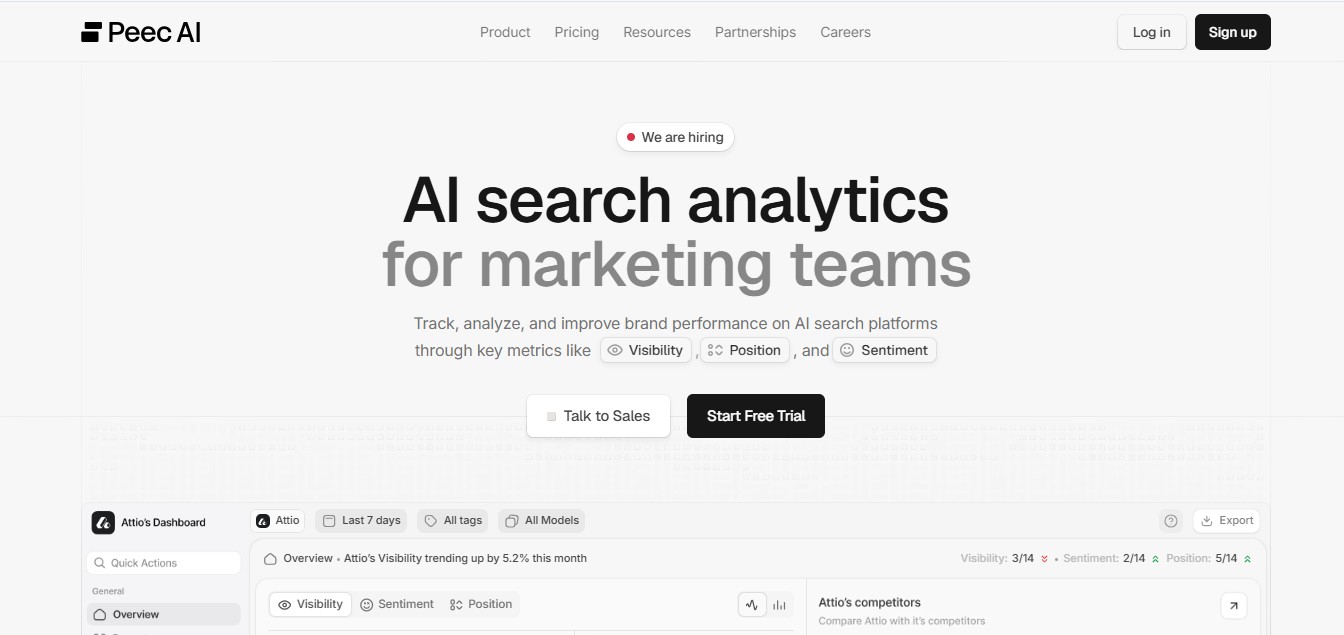
Peec AI is an AI search analytics platform for marketing teams, especially B2B and SaaS companies. Its reporting focuses on visibility, average position, sentiment, and share of voice.
This makes Peec AI useful when a business wants to understand how AI tools position its brand within a software category. A company can monitor whether it is shown as an enterprise solution, an affordable option, a product for small teams, a niche provider, or an alternative to a larger competitor.
Peec AI also includes prompt suggestions, citation insights, competitor reporting, strategy recommendations, multi-country features, integrations, and reporting options.
Key Features
- Visibility tracking.
- Average position reporting.
- Brand sentiment analysis.
- AI share-of-voice reporting.
- Competitor comparisons.
- Prompt suggestions.
- Citation and source analysis.
- Strategic recommendations.
- Daily tracking.
- Unlimited users.
- Multi-country tracking on Advanced.
- CSV exports.
- Looker Studio integration.
- API access.
- MCP access.
Best Use Cases
- B2B SaaS brands: Track category terms, alternative searches, product comparisons, and enterprise solution prompts.
- Product marketing teams: Review how AI answers position a product compared with competitors.
- Content teams: Use prompt suggestions and citations to plan new landing pages, tutorials, comparison pages, and guides.
- Agencies: Track clients, manage prompt groups, and deliver strategic reports.
- Data-focused teams: Connect AI visibility data with Looker Studio or API workflows.
- International companies: Use Advanced or Enterprise for multi-country tracking.
Pros and Cons
| Pros | Considerations |
| Clear focus on visibility, position, sentiment, and share of voice | Entry plans support three selected models |
| Unlimited users on public plans | Broader model coverage can require add-ons |
| Includes prompt suggestions and strategic recommendations | Multi-country tracking begins on Advanced |
| Offers citations, competitors, exports, and integrations | More expensive than entry-level trackers |
| Suitable for B2B positioning work | Larger programs may need Advanced or Enterprise |
Pricing
| Plan | Price | Prompts | Projects | Main inclusions |
| Starter | $95/month | 50 | 1 | Choose three models, unlimited users, daily tracking |
| Pro | $245/month | 150 | 2 | More prompts, unlimited users, daily tracking |
| Advanced | $495/month | 350 | 5 | Multi-country tracking, Looker Studio integration |
| Enterprise | Custom | Custom | Unlimited | All models, custom prompts, API access, SSO |
AthenaHQ — Best for Generative Engine Optimization Teams

AthenaHQ is a generative engine optimization platform for teams that need broad AI model coverage and detailed response analysis. It supports more than 10 AI models on its Starter plan, including ChatGPT, Perplexity, Claude, Gemini, Copilot, Grok, DeepSeek, Meta AI, Mistral, Google AI Mode, and Google AI Overviews.
The platform uses a credit-based approach. Teams can analyze prompts and responses, review competitors, explore citations, receive content recommendations, and act on visibility opportunities.
AthenaHQ is suited to companies building a formal GEO or answer engine optimization program. Its enterprise plan includes advanced reporting, persona targeting, multilingual support, regional tracking, data connections, access controls, and specialized support.
Key Features
- Visibility tracking across more than 10 AI models.
- Prompt and response analysis.
- Competitor insights.
- Content recommendations.
- Content optimization agent.
- Citation analysis.
- Athena Citation Engine.
- Prompt-volume information.
- On-page and off-page action recommendations.
- CSV exports.
- API access.
- Integrations.
- Multi-region tracking.
- Multilingual support.
- Persona targeting.
- Executive dashboards.
- SSO and audit logs.
Best Use Cases
- GEO teams: Monitor AI visibility and turn data into content, citation, and optimization actions.
- Enterprise brands: Track a wide range of AI platforms from a single program.
- International teams: Use Enterprise features for multiple regions, languages, and audience personas.
- Marketing leaders: Connect reporting with Tableau, Power BI, or Looker.
- Content operations teams: Use prompt and response analysis to improve coverage of key topics.
- Organizations with governance needs: Use enterprise access controls, audit logs, and SSO.
Pros and Cons
| Pros | Considerations |
| Supports more than 10 AI models on Starter | Paid Starter plan begins at $295 per month |
| Free Essential plan is available | Credit usage needs to be planned |
| Includes content recommendations and optimization actions | Enterprise capabilities require a custom plan |
| Supports citations, competitors, and prompt analysis | Small teams may not need its full depth |
| Strong international and reporting capabilities | Teams should understand how credits are consumed |
Pricing
| Plan | Price | Main inclusions |
| Essential | Free | $25 free credit, unlimited members, prompt analysis, competitor insights, content recommendations |
| Starter | $295/month | $300 monthly credit, 10+ AI models, exports, integrations, content optimization actions |
| Enterprise | Custom | Custom credits, citation engine, SSO, multilingual support, persona targeting, executive dashboards |
Scrunch AI — Best for Advanced Enterprise Reporting
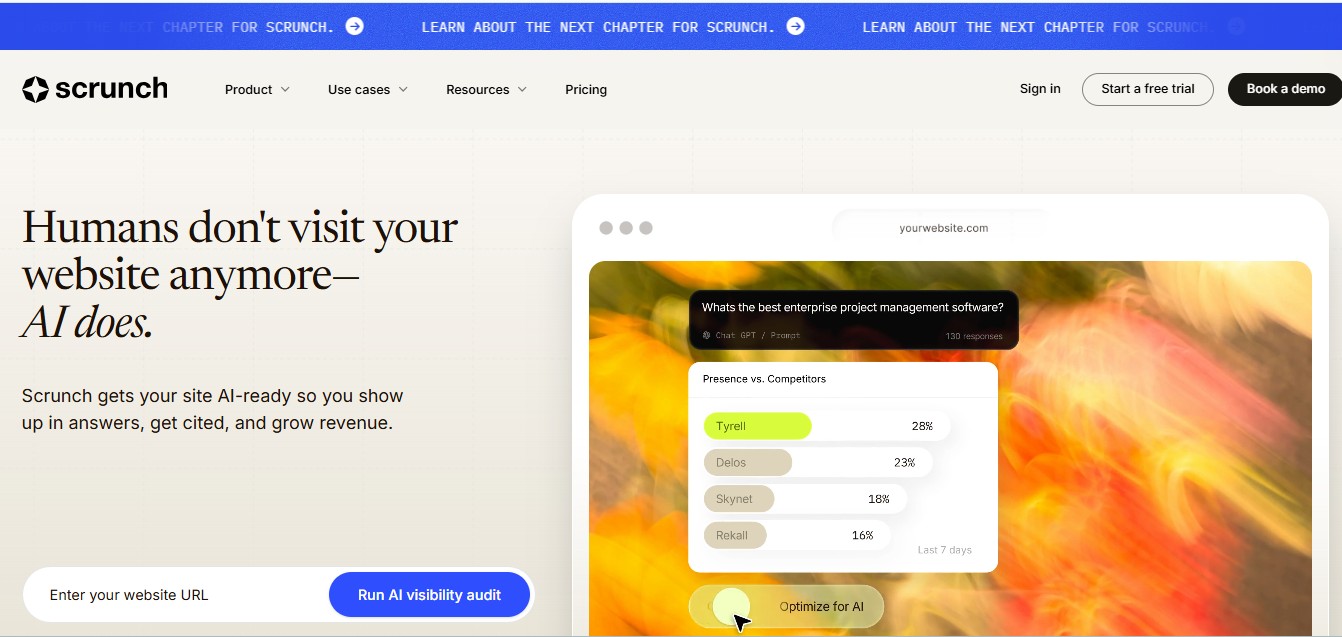
Scrunch AI combines AI visibility monitoring with website auditing and AI-agent experience improvements. It is built for organizations that want to understand how AI platforms discover, interpret, cite, and present their content.
The Core plan supports ChatGPT, Perplexity, Google AI Overviews, and Microsoft Copilot. Enterprise expands model coverage and adds the Agent Experience Platform, complete site audits, custom workspaces, integrations, API access, SSO, and dedicated account support.
Scrunch is a useful choice for technical SEO teams and enterprise websites that want AI visibility reporting tied closely to website structure, crawlability, content quality, and agent access.
Key Features
- Prompt monitoring.
- Topic and entity tracking.
- Brand and citation reporting.
- AI rankings.
- Competitor analysis.
- Persona and geography reporting.
- AI bot behavior analysis.
- Crawl-error monitoring.
- Site audits.
- Optimization guidance.
- Agent Experience Platform.
- Structured page versions for AI agents.
- API access.
- Integrations.
- SSO on Enterprise.
- Expanded AI model coverage on Enterprise.
Best Use Cases
- Enterprise websites: Review AI discoverability, citations, rankings, and technical access.
- Technical SEO teams: Study bot access, crawl errors, structured content, and AI-readiness issues.
- Large brands: Monitor entity-level visibility across products, services, and topics.
- Website teams: Improve how AI agents access and interpret web content.
- Companies with complex web properties: Use site audits and structured AI-agent delivery features.
- Organizations that need enterprise support: Use custom workspaces, API access, SSO, and dedicated account management.
Pros and Cons
| Pros | Considerations |
| Combines AI visibility tracking with site audits | Core starts at $250 per month |
| Tracks AI bot behavior and crawl issues | Core supports four main AI platforms |
| Includes a technical website-focused angle | Expanded AI model coverage requires Enterprise |
| Agent Experience Platform offers a distinct capability | Enterprise pricing is custom |
| Core includes 125 prompts and five monthly audits | Small teams may not require advanced technical features |
Pricing
| Plan | Price | Main inclusions |
| Core | $250/month | 125 prompts, five site audits monthly, one brand workspace, five users, four AI platforms |
| Enterprise | Custom | Custom prompts, complete audits, Agent Experience Platform, API access, SSO, expanded model coverage |
SE Ranking SE Visible — Best for SEO Teams Adding AI Visibility Reporting
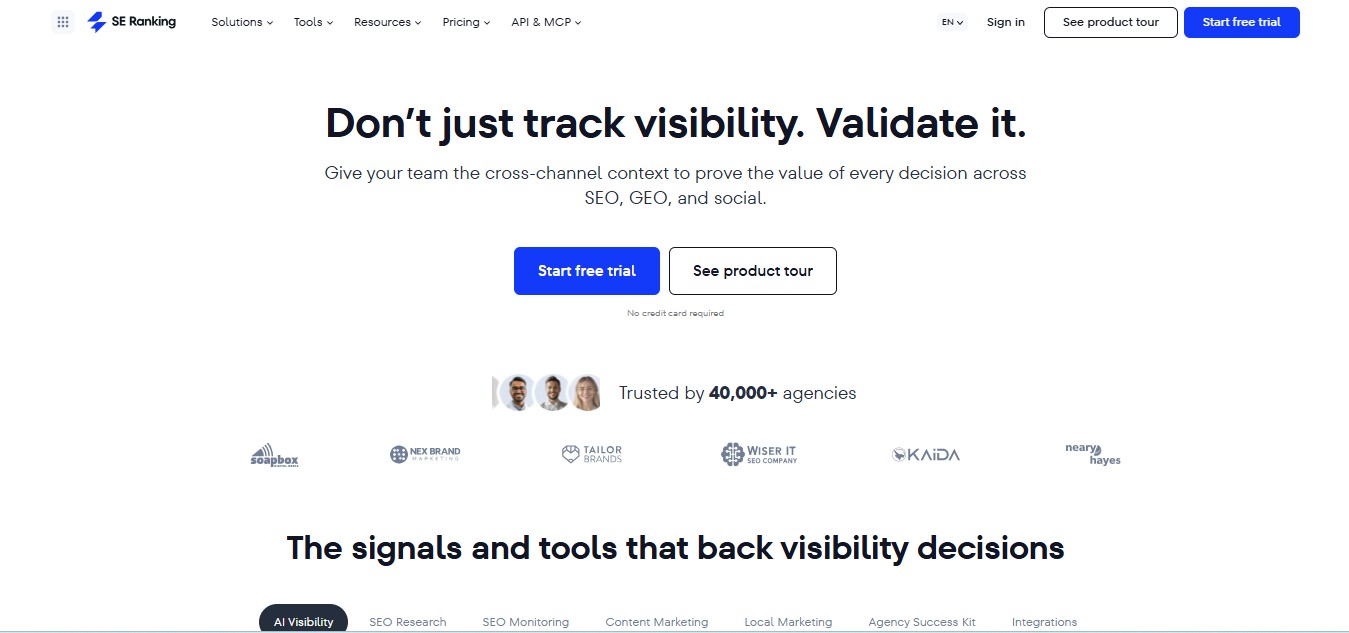
SE Ranking SE Visible is designed for marketing teams and agencies that want to add AI visibility data to broader SEO and GEO reporting. It tracks ChatGPT, Gemini, Perplexity, Google AI Mode, and Google AI Overviews.
The platform monitors brand mentions, citations, links, sentiment, competitors, prompts, and topic-level visibility. It can be a useful choice for agencies because it supports multiple brands, unlimited seats, reporting workflows, and various integrations.
SE Visible also fits teams that want to connect AI visibility work with traditional rank tracking, keyword research, backlink analysis, technical auditing, Google Analytics, and Google Search Console.
Key Features
- AI brand visibility tracking.
- ChatGPT rank tracker features.
- Prompt-level monitoring.
- Brand mentions and links.
- Citation reporting.
- Sentiment analysis.
- Competitor benchmarking.
- Visibility score.
- Net sentiment score.
- Topic and prompt insights.
- Suggested prompt research.
- Custom prompts.
- Multi-brand reporting.
- Unlimited user seats.
- Agency dashboards.
- API access.
- MCP access.
- Google Analytics and Search Console integrations.
- Looker Studio, Zapier, Make, n8n, and other automation connections.
Best Use Cases
- SEO agencies: Manage AI visibility reports across multiple client brands.
- In-house SEO teams: Combine traditional SEO reporting with AI mention and citation monitoring.
- Marketing leaders: Monitor sentiment, competitors, topics, and brand presence at a higher level.
- Content teams: Discover prompts and cited sources that may shape new content priorities.
- Teams needing integrations: Connect AI visibility reporting to dashboards and automations.
- Multi-brand organizations: Track several business units or client websites from one platform.
Pros and Cons
| Pros | Considerations |
| Fits well with broader SEO and GEO reporting | SE Visible is separate from standard SE Ranking subscriptions |
| Tracks ChatGPT, Gemini, Perplexity, AI Mode, and AI Overviews | Entry-level plan limits should be confirmed before subscribing |
| Includes citations, sentiment, competitors, topics, and prompts | AI update frequency may differ from daily prompt tracking tools |
| Supports multiple brands and unlimited seats | Higher plans are needed for larger brand portfolios |
| Offers reporting and automation integrations | Teams should compare SE Visible with SE Ranking’s AI Search options |
Pricing
| Plan | Starting price | Prompts | Brands | Main inclusions |
| Basic | $99/month | Plan-based | Plan-based | AI visibility tracking for smaller teams |
| Core | $189/month | 450 | 5 | Visibility, sentiment, prompts, topics, and competitor reporting |
| Plus | $355/month | 1,000 | 10 | Larger multi-brand tracking capacity |
| Max | $519/month | 1,500 | 15 | Advanced monitoring and reporting |
| Enterprise | Custom | Custom | Custom | Custom tracking and organizational requirements |
GetAirefs — Best for AI Visibility Research and Content Opportunities
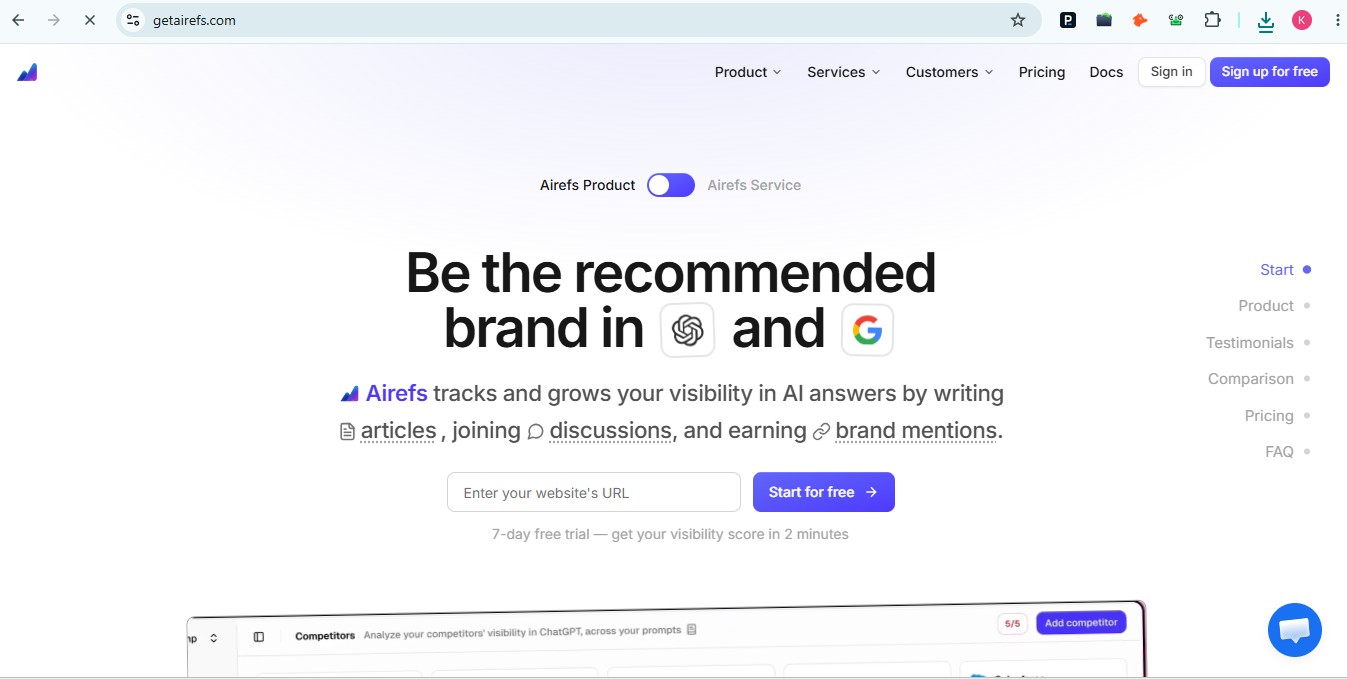
GetAirefs, also known as Airefs, combines ChatGPT visibility tracking with AEO content creation, Reddit monitoring, competitor research, citation opportunities, and outreach support.
It is designed for teams that want to identify AI visibility gaps and take practical content action. Instead of only showing whether a brand is visible, it helps users find missed prompts, relevant Reddit discussions, citation opportunities, and article topics.
GetAirefs is suitable for small businesses, affiliate marketers, content publishers, agencies, and brands that want AI search tools with content execution support.
Key Features
- ChatGPT prompt tracking.
- Optional Google AI Overview tracking.
- AI analytics.
- Competitor tracking.
- Opportunity research.
- Reddit keyword monitoring.
- AEO and SEO article creation.
- Cited article research.
- Outreach opportunity discovery.
- MCP server access on Pro and Expert.
- Done-for-you AI visibility support.
- Domain, seat, and article allowances based on plan.
Best Use Cases
- Small businesses: Begin with a lower-cost prompt tracking and content plan.
- Affiliate publishers: Find comparison, review, alternatives, and buying-guide opportunities.
- Content marketers: Use AEO article allowances to publish around missing prompts.
- Reddit-focused brands: Identify relevant community conversations.
- Agencies: Track several domains and use content support for client work.
- Teams needing more execution help: Consider done-for-you content, strategy, optimization, and outreach support.
Pros and Cons
| Pros | Considerations |
| Starts at $24 per month with annual billing | Primary prompt tracking focuses on ChatGPT |
| Includes AEO article allowances | Google AI Overview tracking is an add-on |
| Offers Reddit keyword monitoring | Lite includes one domain and one seat |
| Includes opportunity and outreach research | AI analytics history is limited on Lite |
| Pro offers a 7-day trial | Full multi-model tracking is not its main focus |
| Done-for-you option available | Extra AI Overview tracking increases the total price |
Pricing
| Plan | Annual price | Monthly price | Prompts | Main inclusions |
| Lite | $24/month | $29/month | 25 | One domain, one seat, AI analytics, opportunities, one AEO article |
| Pro | $49/month | $59/month | 60 | Three domains, two seats, three AEO/SEO articles, MCP server |
| Expert | $83/month | $99/month | 150 | Unlimited domains, 20 seats, six AEO/SEO articles, AEO strategist |
| Done-for-you | From $300/month | From $300/month | Includes Pro-level access | Strategy, content, site optimization, and outreach support |
Promptwatch — Best for Ongoing Prompt Monitoring and Brand Alerts
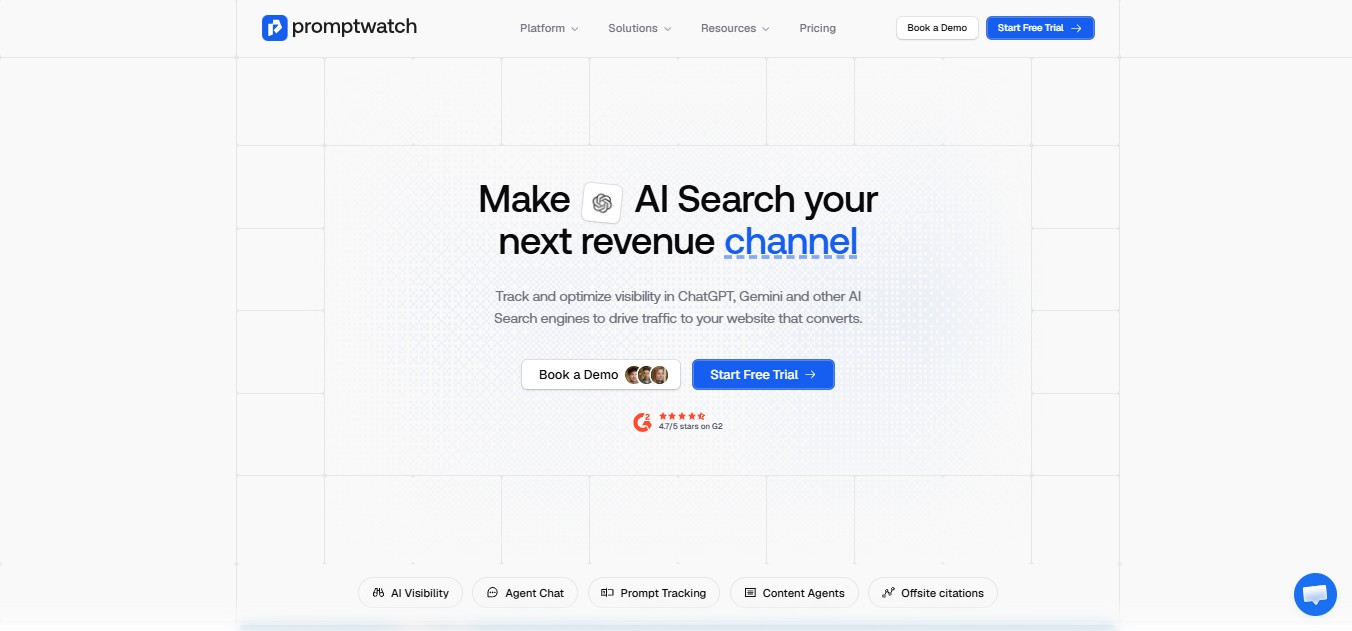
Promptwatch is an AI search visibility platform for teams that want ongoing monitoring across prompts, citations, competitors, AI crawlers, content gaps, and AI-generated traffic.
It tracks brand presence across ChatGPT and other supported AI search platforms. Its reporting can help marketers see whether their brand is gaining or losing visibility, whether a competitor becomes more prominent, whether citations change, or whether new content gaps appear.
Promptwatch is well suited to brands and agencies that want an ongoing monitoring system instead of a one-time AI visibility audit.
Key Features
- ChatGPT visibility tracking.
- Prompt-level reporting.
- Brand mention tracking.
- Citation monitoring.
- External citation opportunities.
- Competitor reporting.
- Share of voice.
- Sentiment analysis.
- AI crawler logs.
- AI referral traffic reporting.
- Content-gap analysis.
- Content recommendations.
- AEO articles.
- Agent Chat.
- Knowledge base.
- Agent analytics.
- MCP and API access.
- Country, state, and city-level tracking on Business.
- Shopping Insights.
- Ads Radar.
Best Use Cases
- Brands with recurring monitoring needs: Track important prompts each week or month.
- Agencies: Manage projects, reporting, citations, and content workflows for clients.
- Content teams: Use content gaps and AEO articles to improve coverage of priority prompts.
- Technical teams: Review AI crawler data and AI referral traffic.
- Local brands: Use country, state, and city-level tracking on Business.
- E-commerce teams: Use Shopping Insights and Ads Radar to study AI shopping-related visibility.
- Marketing managers: Monitor competitor shifts, citations, sentiment, and prompt-level changes.
Pros and Cons
| Pros | Considerations |
| Combines prompt tracking, citations, competitors, sentiment, crawler data, and content workflows | Entry plan starts at $95 per month |
| Essential includes 50 prompts and 6,000 responses monthly | Essential does not include AEO articles |
| API and MCP access are included on listed plans | Teams should confirm model coverage for the selected package |
| Professional and Business include article allowances | Advanced regional features require Business |
| Business includes local, shopping, and ads-related features | Larger prompt lists require Professional or Business |
| Offers a free trial | Smaller teams may prefer a lower-cost entry plan elsewhere |
Pricing
| Plan | Price | Projects | Prompts | Responses per month | Main inclusions |
| Essential | $95/month | 1 | 50 | 6,000 | Four models, Agent Chat, MCP and API access |
| Professional | $245/month | 2 | 150 | 18,000 | Five AEO articles, knowledge base, crawler data, agent analytics |
| Business | $579/month | 5 | 350 | 42,000 | Ten AEO articles, country/state/city tracking, Shopping Insights, Ads Radar |
| Custom | Custom | Custom | Custom | Custom | Brand, agency, and enterprise plans |
Final Verdict
Radarkit is the best alternative tool to choose for brands that want a practical and affordable way to measure ChatGPT visibility. It brings together the core features most teams need without requiring an enterprise-level budget from day one.
At $29 per month, Radarkit tracks ChatGPT, Perplexity, Gemini, Microsoft Copilot, Google AI Mode, and Google AI Overviews. It also supports 50+ locations, citations, competitor monitoring, average position, sentiment, share of voice, query fanouts, AI traffic analytics, Google Search Console integration, and AI-focused agents.
This balance makes Radarkit suitable for many different users:
- Small businesses testing ChatGPT visibility tracking for the first time.
- SaaS companies monitoring category and alternatives prompts.
- Agencies tracking several client brands.
- Content teams reviewing citations and missing topic opportunities.
- Local businesses checking AI visibility across target markets.
- SEO teams that want AI search data alongside traffic and content insights.
Other tools may be a stronger fit for specific situations. Semrush and Ahrefs work well for teams that already rely on those SEO suites. Profound, AthenaHQ, Scrunch, and Promptwatch are suitable for larger AI-search programs with advanced reporting, enterprise controls, or specialized workflows.
However, Radarkit offers the most balanced choice for brands that need multi-model coverage, actionable reporting, location-based tracking, and useful content workflows at a starting price that is easier to test and scale.
FAQ
What are ChatGPT visibility trackers for brands?
ChatGPT visibility trackers for brands are tools that monitor whether a business, product, website, or competitor appears in ChatGPT answers. Many also track visibility in Perplexity, Gemini, Copilot, Google AI Mode, Google AI Overviews, Claude, and other AI platforms.
They help marketing teams understand how AI systems describe their brand, which prompts include it, which competitors appear, and what sources are cited.
How do tools measure brand visibility in ChatGPT answers?
Most ChatGPT visibility trackers for brands run a selected list of prompts through ChatGPT and other AI tools. They then record the answers and look for brand names, product names, website domains, competitors, citations, and descriptive language.
The platform may convert the results into metrics such as:
- Brand mention rate
- Visibility score
- Recommendation rate
- Average position
- Share of voice
- Citation rate
- Sentiment
- Competitor presence
- Prompt-level trends
The results should be viewed as a structured measurement across a selected prompt group. AI answers can change based on the wording of the question, model updates, user location, browsing settings, and context.
Can ChatGPT visibility tracking measure recommendations?
Yes. A ChatGPT rank tracker can often identify whether a brand appears as a recommendation in an AI answer.
If ChatGPT creates a numbered or ordered list of options, some platforms can also estimate the average position of each brand. If the response is conversational and does not use a clear order, the tool may report a mention, recommendation, visibility score, or share-of-voice metric instead.
Can these tools track citations and sentiment?
Many AI visibility trackers can track citations. Citation data can show the URLs, domains, publishers, reviews, guides, product pages, community discussions, and other sources that AI systems use in their answers.
Several tools also include sentiment analysis. This helps marketers understand whether a brand is described positively, neutrally, or in a more limited context. It is useful because a mention alone does not explain how the AI platform positions the company.
Which platforms support competitor and prompt-level reporting?
All 11 tools in this guide support some form of prompt-level and competitor reporting. The depth varies between platforms.
Radarkit, Profound, Otterly.AI, Semrush, Ahrefs Brand Radar, Peec AI, AthenaHQ, Scrunch AI, SE Ranking SE Visible, GetAirefs, and Promptwatch can all help brands compare performance across prompts or against competitors.
Radarkit is particularly useful for teams that want competitor tables, citations, sentiment, average position, share of voice, query fanouts, local tracking, and AI traffic analytics in one workflow.
Which ChatGPT visibility tracker is best for small businesses?
Radarkit is a strong option for small businesses because it starts at $29 per month and includes multi-model tracking, two projects, 15 prompts, 50+ locations, Google Search Console integration, and AI-focused agents.
Otterly.AI also starts at $29 per month, while GetAirefs starts at $24 per month with annual billing. The right choice depends on whether the business needs broad multi-model tracking, agency features, or content and AEO article support.
Should brands track only ChatGPT?
No. ChatGPT is important, but many people also use Perplexity, Gemini, Microsoft Copilot, Google AI Mode, Google AI Overviews, and Claude for research and recommendations.
A brand may appear often in ChatGPT but be missing from another AI platform. Monitoring multiple AI search tools provides a broader picture of how customers may discover a brand through AI-generated answers.
