

Gemini Visibility Trackers for Brands help marketing teams measure whether Google Gemini mentions, recommends, or cites their brand when people ask discovery, comparison, and purchase-intent questions. Unlike conventional rank trackers that focus on organic positions, these platforms assess brand mentions, answer position, share of voice, sentiment, citation sources, competitors, and—in some cases—whether an AI crawler can properly retrieve and understand a website.
This category now sits at the intersection of SEO, content marketing, digital PR, technical SEO, and brand measurement. A company may rank well in Google’s traditional results yet be absent from Gemini responses for queries such as “best project management platform for remote teams,” “best skincare brands for sensitive skin,” or “top payroll software for startups.” A good visibility tracker makes those gaps visible, shows which competitors and sources appear instead, and helps teams decide what to update, create, or promote.
The 14 platforms below were assessed on Gemini availability, multi-engine coverage, prompt limits, citation analysis, competitor reporting, local and multilingual tracking, integrations, actionability, reporting, and latest published pricing. Pricing is based on the attached vendor screenshots and was checked in September 2026; annual billing is noted where applicable.
Quick Pick Criteria
- Radarkit: Best overall for affordable Gemini tracking, broad model coverage, local visibility research, and built-in content/outreach workflows.
- Semrush: Best for organizations already using Semrush for SEO, keyword research, content, and competitor intelligence.
- Ahrefs: Best for large-scale market and prompt discovery using a substantial search-backed prompt database.
- Profound: Best for enterprise organizations that need broad model coverage, real-conversation intelligence, and advanced governance.
- Scrunch: Best for technical teams that need AI-answer monitoring plus crawler, site-audit, and AI-agent traffic insights.
- AthenaHQ: Best for teams that want persona-based visibility analysis, content recommendations, and enterprise reporting.
- Nightwatch: Best for agencies and SEO teams combining local rank tracking, AI prompt monitoring, and client reporting.
- Peec AI: Best for clean reporting workflows, unlimited users, and agencies monitoring a defined set of brands and prompts.
- SE Ranking: Best for mid-market teams that want traditional SEO, AI-result tracking, audits, and competitor research in one stack.
- Surfer: Best for content teams that want to connect visibility gaps with content briefs, optimization, and publishing workflows.
- Rankscale: Best for teams that prioritize broad engine coverage, page-level audits, and flexible credit-based sampling.
- HubSpot AEO: Best for CRM-led teams that want visibility data tied to marketing operations, buyer journeys, and HubSpot workflows.
- LLMrefs: Best for cost-conscious teams needing high prompt allowances, country/language targeting, and straightforward multi-engine monitoring.
- Otterly.ai: Best budget-friendly tracker for small teams that want daily tracking, audits, and reporting without an enterprise contract.
Quick Comparison Table
| Tool | Gemini support | Starting price | Primary strength | Best suited to |
| Radarkit | Yes | $29/mo | Tracking plus content, outreach, Reddit, and chat agents | SMBs, agencies, and multi-location brands |
| Semrush | Yes | $165.17/mo for SEO + AI plan shown | Mature SEO suite and AI visibility reporting | Existing Semrush customers |
| Ahrefs | Yes | $129/mo; Brand Radar has separate costs | Large prompt dataset and market intelligence | Enterprise SEO and brand teams |
| Profound | Yes on higher tiers | $99/mo | Real-prompt intelligence and enterprise controls | Large brands and regulated organizations |
| Scrunch | Yes on Enterprise | $250/mo | Site diagnostics, agent traffic, AXP | Technical SEO and web platform teams |
| AthenaHQ | Yes | Free; $295/mo Starter | Persona analysis and recommendation workflows | Enterprise marketing teams |
| Nightwatch | Yes | €99/mo | Rank tracking plus prompt monitoring | Agencies and SEO teams |
| Peec AI | Yes | $80/mo annually | Clear dashboards and unlimited users | Agencies and collaborative SEO teams |
| SE Ranking | Yes | $103.20/mo annually | SEO toolkit plus multi-engine monitoring | Mid-market and agency teams |
| Surfer | Yes | $158/mo for AI Search Analytics | Content optimization tied to visibility data | Content-led SEO teams |
| Rankscale | Yes | From $20/mo | 17+ engines and page-level readiness audits | Technical marketers and agencies |
| HubSpot AEO | Yes | $50/mo standalone | CRM-aware visibility recommendations | HubSpot-centric teams |
| LLMrefs | Yes | $79/mo | 500 prompts, geo targeting, unlimited projects | Lean teams and multi-market brands |
| Otterly.ai | Gemini as add-on | $29/mo | Daily tracking and GEO URL audits | Small teams and budget buyers |
Pricing note: Gemini availability and included engine coverage can vary by plan. Always review the exact plan, add-ons, and billing cycle before purchasing.
Top 14 Gemini Visibility Trackers for Brands in 2026: Detailed Comparison and Use Cases
Radarkit – Best Overall for Gemini + Multi‑Engine AI Visibility Tracking
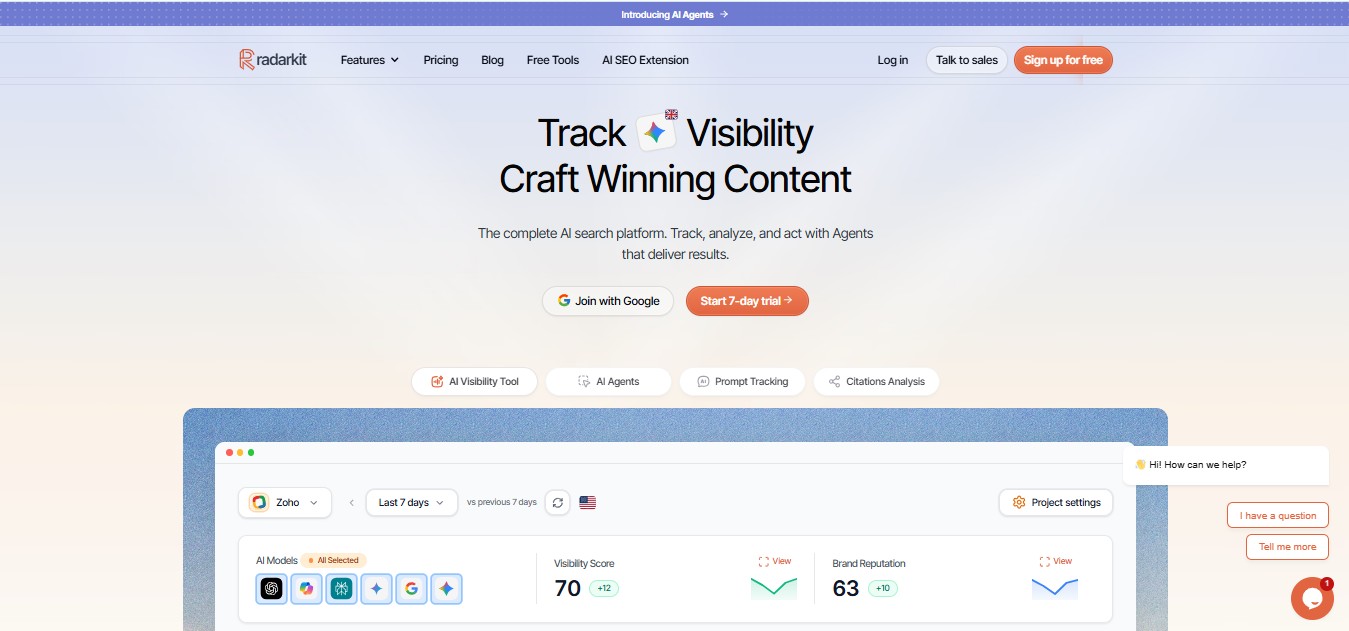
Radarkit is an AI-search visibility platform designed to help brands track how they appear across Gemini, ChatGPT, Perplexity, Google AI Overviews, Google AI Mode, Copilot, and other supported answer engines. Its core proposition is practical: identify where a brand is missing, see which competitors are winning the answer, inspect cited sources, and use integrated agents to create an action plan.
This makes Radarkit especially useful for teams that do not want separate products for measurement, content ideation, outreach prioritization, and community research. Rather than treating visibility tracking as a dashboard-only exercise, it combines prompt tracking with Content, Outreach, Reddit, and Chat agents. The platform also includes Google Search Console integration, which helps users compare AI-answer visibility with traditional search performance.
Key Features for Gemini Visibility
- Tracks visibility across Gemini and other answer engines from the same workspace
- Measures brand mentions, competitor mentions, citations, share of voice, and answer-level presence
- Supports prompt tracking across 50+ locations on standard plans and 70+ locations on Enterprise
- Includes daily refreshes on Growth and Pro plans; Lite has a 72-hour refresh cycle
- Provides Content Agent workflows for creating content briefs and identifying topical gaps
- Includes Outreach and Reddit agents for identifying third-party visibility opportunities and relevant discussion areas
- Connects with Google Search Console to align organic-search signals with AI-answer visibility
- Offers API, SSO, custom prompts, custom contract terms, and unlimited seats at Enterprise level
Pricing, Plans, and Who It’s Best For
| Radarkit plan | Price | Included tracking |
| Lite | $29/mo | 2 projects, 15 prompts, 72-hour refresh |
| Growth | $79/mo | 5 projects, 50 prompts, daily refresh |
| Pro | $139/mo | 10 projects, 100 prompts, daily refresh |
| Enterprise | Custom | Unlimited projects, custom prompts, 70+ locations, API, SSO |
Radarkit’s pricing is accessible compared with enterprise-first trackers. The Lite plan suits individual marketers and small businesses validating whether their brand appears in Gemini and comparable models. Growth is the practical starting point for an in-house marketing team because it adds daily refreshes and a larger prompt set. Pro is more appropriate for agencies, multi-product brands, or teams that need separate projects for markets, product lines, or clients.
Ideal Use Cases and Example Workflow
Radarkit is a strong fit for SaaS businesses, local service companies, ecommerce brands, SEO agencies, and content teams that need to translate data into work quickly.
For example, a B2B software company can track prompts such as:
- “Best CRM software for small businesses”
- “Top alternatives to [competitor]”
- “Best sales automation software for agencies”
- “Affordable customer relationship management software”
- “Best CRM tools for Indian startups”
The team can then identify prompts where Gemini does not mention the brand, compare cited sources against competitors, create or improve relevant pages, and use outreach insights to pursue coverage from publications or resource pages that frequently influence answers.
Best for: teams seeking the most balanced mix of price, multi-engine tracking, location coverage, actionable workflows, and scalability without starting with an expensive enterprise contract.
Semrush AI Visibility Toolkit – Best for Teams Already Running Semrush
How Semrush Tracks Gemini and Other AI Engines
Semrush’s AI Visibility Toolkit measures how a brand appears in Gemini, ChatGPT, Google AI Overviews, Perplexity, and related search-answer surfaces. Its reporting focuses on visibility score, brand mentions, citation frequency, share of voice, sentiment, competitor comparisons, and prompts that trigger brand appearances.
The advantage is continuity with the rest of the Semrush environment. A team can connect keyword research, organic rankings, backlinks, site auditing, content optimization, and AI-search visibility in a familiar workflow.
Strengths for Enterprise SEO and Reporting
- Strong fit for companies already paying for Semrush SEO capabilities
- Connects AI-answer monitoring with keyword research, content workflows, site audits, and competitor research
- Offers share-of-voice and sentiment views that work well for executive reporting
- Supports multi-site and multi-market monitoring in higher tiers
- Has enterprise-grade reporting and data-export options
- Reduces training and onboarding needs for teams already using Semrush daily
The main consideration is cost scaling. Semrush can be efficient when AI visibility is part of a broader SEO program, but a team that only needs prompt-level tracking may find a specialist tool more economical.
Pricing and When It Makes Sense
The SEO + AI pricing shown begins at $165.17 per month for Starter, which includes 50 AI prompts to track daily. Pro+ is $248.17 per month with 100 daily AI prompts, while Advanced is $455.67 per month with 200 daily AI prompts.
Semrush also offers AI visibility products as separate or bundled toolkits depending on the account configuration. Check whether you are paying for a standalone toolkit, an SEO + AI plan, or extra prompt capacity.
Best for: established SEO departments that already rely on Semrush and want AI visibility inside the same operating system.
Ahrefs Brand Radar – Best for Large‑Scale Prompt and Market Discovery
Ahrefs Brand Radar is built around large-scale prompt intelligence. It uses a search-backed prompt corpus to help teams understand where brands appear, which competitors dominate, what topics drive visibility, and where citations originate.
Rather than beginning only with a manually assembled list of 50 or 100 prompts, a brand can explore broad categories, competitor visibility, topic clusters, and historical patterns. This is particularly useful for brands with large product catalogs, multiple regions, or complex competitive landscapes.
Citation and Cross‑Channel Research
Ahrefs Brand Radar supports analysis of AI mentions and cited pages across Gemini, Google AI Overviews, Google AI Mode, ChatGPT, Perplexity, Copilot, and other supported channels. It also connects AI visibility research with Ahrefs’ backlink, content, keyword, and technical SEO data.
A typical workflow is:
- Find topics where competitors appear in Gemini
- Identify cited domains and pages
- Review their backlinks, content format, search traffic, and keyword footprint
- Build a content or digital PR plan around observed citation patterns
Pricing and Fit for Brand/PR Teams
The core Ahrefs plans shown are $129 per month for Lite, $249 for Standard, and $449 for Advanced. They include 5, 10, and 20 tracked AI prompts, respectively.
Brand Radar is separately priced or configured. Costs can vary based on the platform package, breadth of engine coverage, and whether custom prompt tracking is included.
Best for: large SEO, content, PR, and brand teams that need broad market intelligence—not merely a small fixed prompt list.
Profound – Best for Enterprise Coverage Across 10+ AI Engines
Conversation Explorer and Real‑Prompt Data
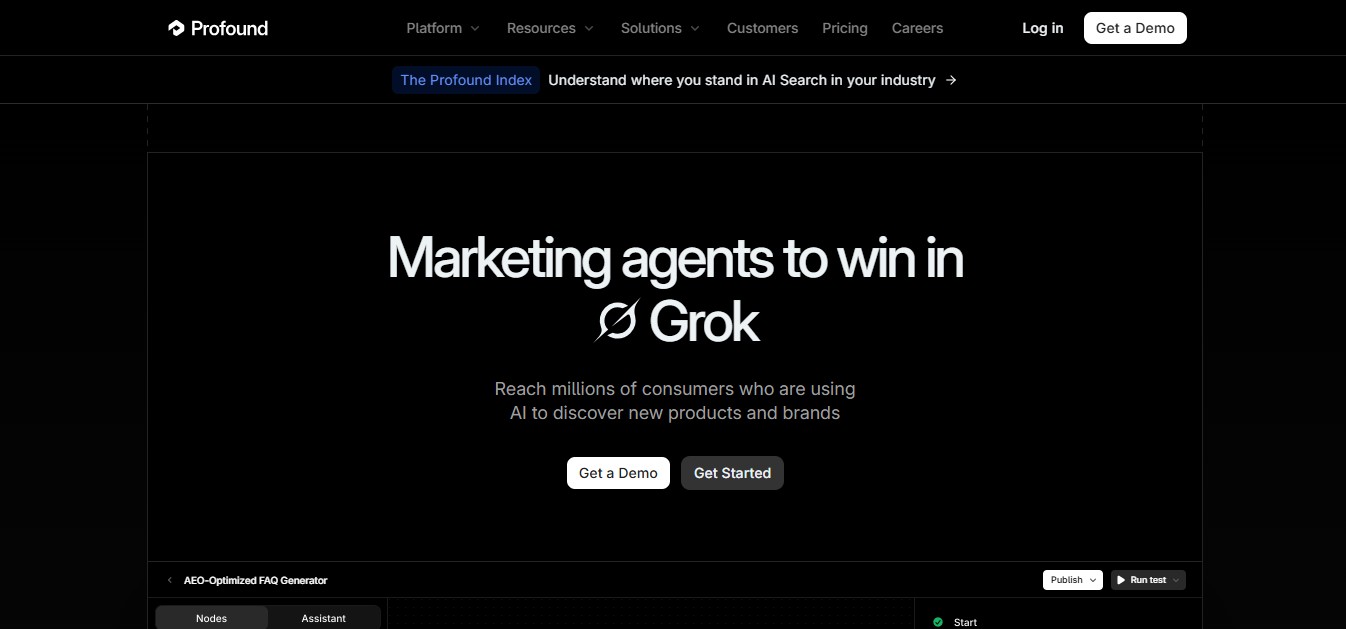
Profound is designed for enterprise answer-engine optimization programs. Its Conversation Explorer and prompt intelligence products aim to show what people ask across answer engines, what answers are generated, which brands and competitors appear, and which pages or third-party sources shape those answers.
The major differentiator is access to large-scale conversation and prompt insights rather than relying entirely on manually created queries. This can help a large brand find opportunities it would not discover by tracking only a limited seed list of prompts.
Security, SOC 2, and Enterprise Features
Profound’s Enterprise offering includes advanced monitoring across multiple answer engines, customized prompt tracking, multiple companies, API access, dedicated support, and SSO/SAML. Its enterprise proposition is built for teams where security, reporting, procurement, cross-department adoption, and data governance matter as much as prompt monitoring.
The wider product ecosystem includes answer-engine insights, prompt research, citation tracking, crawler attribution, agents, and executive reporting.
Pricing Tiers and Ideal Customers
| Profound plan | Price | Notable limit |
| Starter | $99/mo, billed annually | ChatGPT only, 50 prompts |
| Growth | $399/mo, billed annually | 3 answer engines, 100 prompts |
| Enterprise | Custom | Expanded engine coverage and custom capacity |
The Starter plan is best treated as a trial or early-stage option because it focuses on ChatGPT. Brands whose main goal is Gemini visibility should confirm the exact supported models within Growth or Enterprise before buying.
Best for: enterprise companies with significant budgets, governance requirements, and a need for broad answer-engine intelligence.
Scrunch AI – Best for Technical AEO and Crawler Visibility
AXP Delivery and AI Agent Traffic
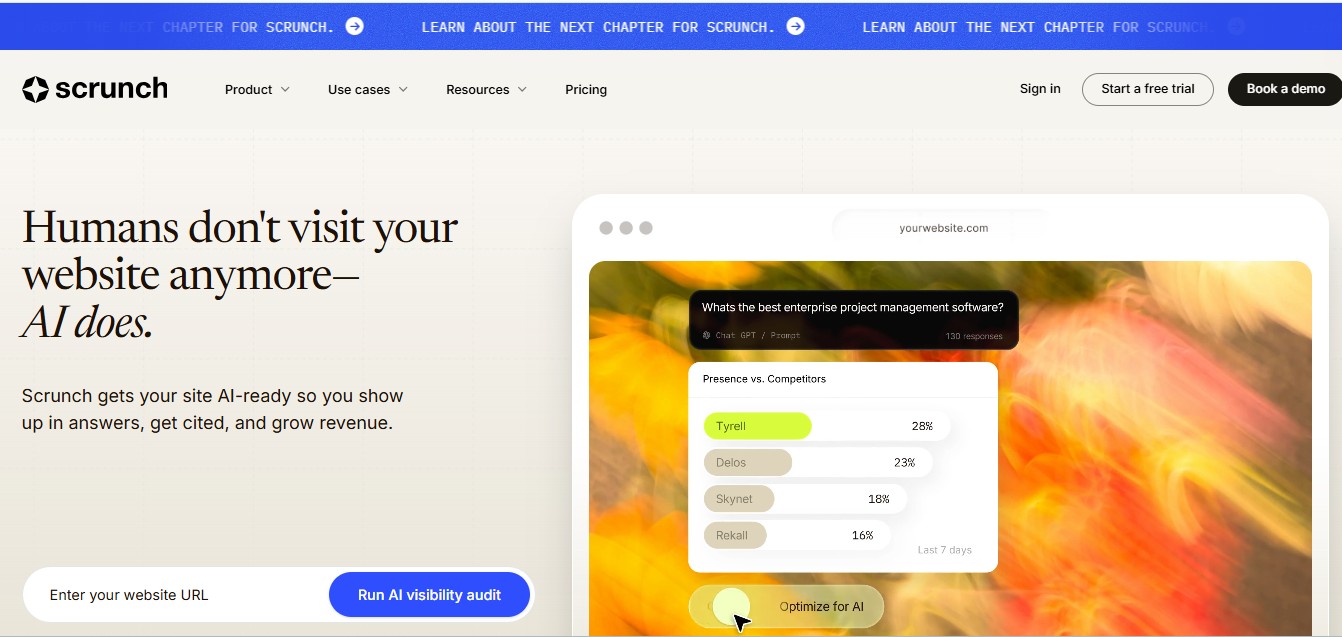
Scrunch takes a more technical approach than a pure brand-mention tracker. Its Agent Experience Platform, or AXP, is built around helping websites become more accessible and useful to AI agents. Alongside answer monitoring, it analyzes AI crawler and agent traffic, page-level readiness, citations, and how agents consume a website.
This makes Scrunch particularly relevant for technical SEO teams asking questions beyond “Are we mentioned in Gemini?”
- Are AI crawlers reaching key product and documentation pages?
- Which pages are difficult for agents to interpret?
- Are citation opportunities constrained by site architecture or incomplete content?
- Which AI bots interact with the site and which pages do they consume?
- Does the website present clear, machine-readable product and service information?
Site Audits Tied to Citations and Conversions
Scrunch combines prompt monitoring, citation analysis, site diagnostics, agent-traffic data, and page audits. This creates a connection between off-site visibility signals and on-site technical readiness.
Its Core plan supports ChatGPT, Perplexity, Google AI Overviews, and Copilot. The Enterprise plan expands to Gemini, Claude, Meta AI, Google AI Mode, Grok, and other models.
Pricing and Technical Team Fit
| Scrunch plan | Price | Included scope |
| Core | $250/mo | 125 prompts, 5 site audits/month, 1 workspace, 5 users |
| Enterprise | Custom | Expanded models, AXP, API, SSO, custom audits, and support |
Scrunch’s Core tier is not the cheapest route to Gemini visibility because Gemini appears in its Enterprise model list. Its value comes from technical diagnostics, agent traffic, and AI-readiness work rather than entry-level prompt monitoring alone.
Best for: enterprise technical SEO, product, and web-platform teams that want to improve AI-agent accessibility as well as measure visibility.
AthenaHQ – Best for Persona‑Aware Prompts and Enterprise Workflows
AI Search Performance and Persona‑Based Tracking
AthenaHQ focuses on monitoring brand performance across multiple answer engines while incorporating buyer personas, competitors, sources, citations, sentiment, and content recommendations. Its Enterprise plan highlights persona targeting, making it appropriate for organizations that need to understand how their brand is presented to different audiences.
This is valuable for B2B companies where broad visibility is not enough. A company may appear for general category questions but be missing from prompts around enterprise security, implementation, integrations, compliance, price, or industry-specific requirements.
Integrations with SEO, Analytics, and Content Ops
AthenaHQ’s Starter plan includes visibility across 10 models, integrations, CSV export, on-page and off-page actions, and a content optimization agent. Enterprise adds multi-region and multilingual support, BI tool support for Tableau, Power BI, and Looker, white-glove onboarding, and advanced access controls.
Enterprise also includes the Athena Citation Engine, claim review, discrepancy detection, organizational activity audit logs, and SAML/OIDC SSO.
Enterprise Pricing and Use Cases
| AthenaHQ plan | Price | Included scope |
| Essential | Free | $25 free credit, unlimited members, prompt and response analysis |
| Starter | $295/mo | $300 monthly credit, 10-model visibility, integrations |
| Enterprise | Custom | Citation engine, audit logs, BI support, persona targeting, SSO |
AthenaHQ uses a credit model rather than a fixed prompt quota. Teams should estimate the number of engines, markets, prompts, and responses they need before comparing it with flat-fee alternatives.
Best for: enterprise B2B marketing teams that need persona segmentation, controlled reporting, and action-oriented recommendations.
Nightwatch – Best Legacy SEO Platform with Built‑In AI Visibility
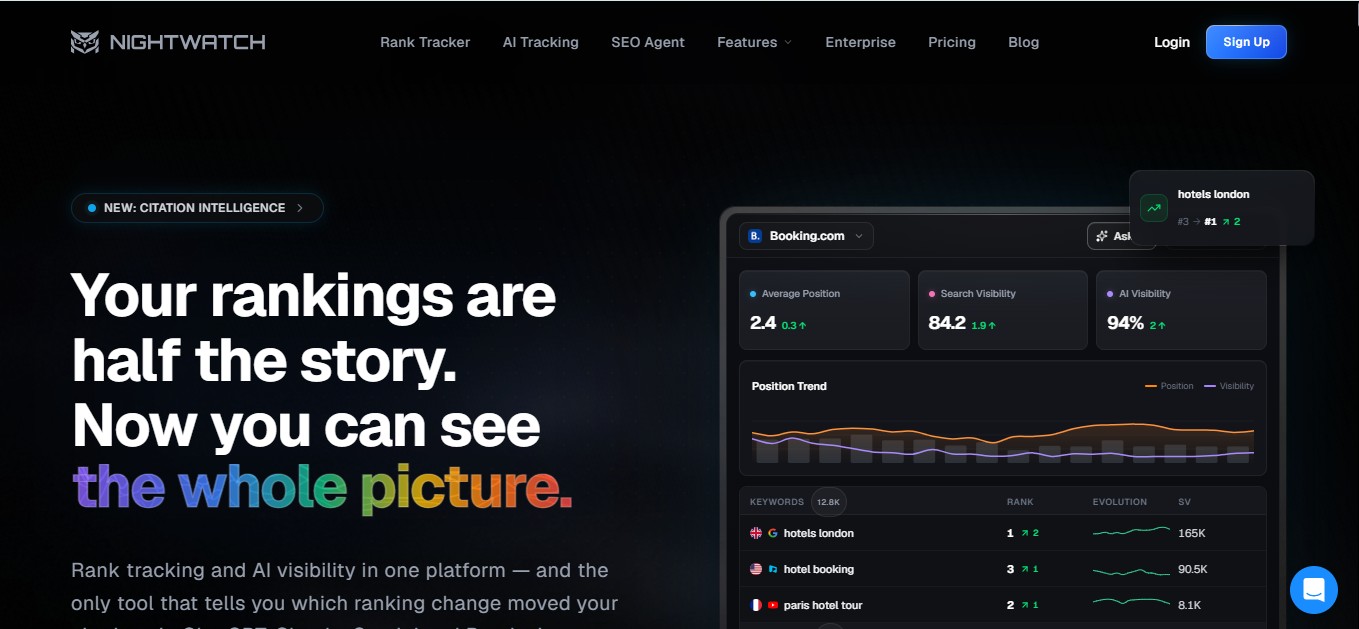
Nightwatch combines a rank-tracking platform with AI-answer monitoring. Its plans include keyword tracking, AI prompt allowances, AI responses, keyword research, site audits, competitor monitoring, and SEO-agent credits.
The platform is useful for agencies managing many client websites because its Agency plan covers 100 websites, 7,500 keywords, 500 AI prompts, and 15,000 AI answers monthly.
DataMind‑Style AI Recommendations and Reporting
Nightwatch offers a blend of rank tracking, visibility reporting, site audits, competitor analysis, and SEO-agent workflows. The benefit is operational simplicity for a team that already manages conventional SEO campaigns and does not want a separate system solely for AI-answer measurement.
For local and international SEO, the ability to evaluate traditional positions and AI citations within one reporting environment can be more valuable than raw model coverage.
| Nightwatch plan | Price shown | AI prompt allowance |
| Starter | €99/mo | 50 prompts |
| Professional | €199/mo | 150 prompts |
| Agency | €499/mo | 500 prompts |
| Enterprise | Custom | Unlimited prompts |
The first three plans include 1,500, 4,500, and 15,000 monthly AI answers, respectively.
Best for: SEO agencies and established teams that need traditional rank tracking and AI visibility in the same client-reporting workflow.
Peec AI – Best Price‑to‑Feature Ratio for Core Monitoring
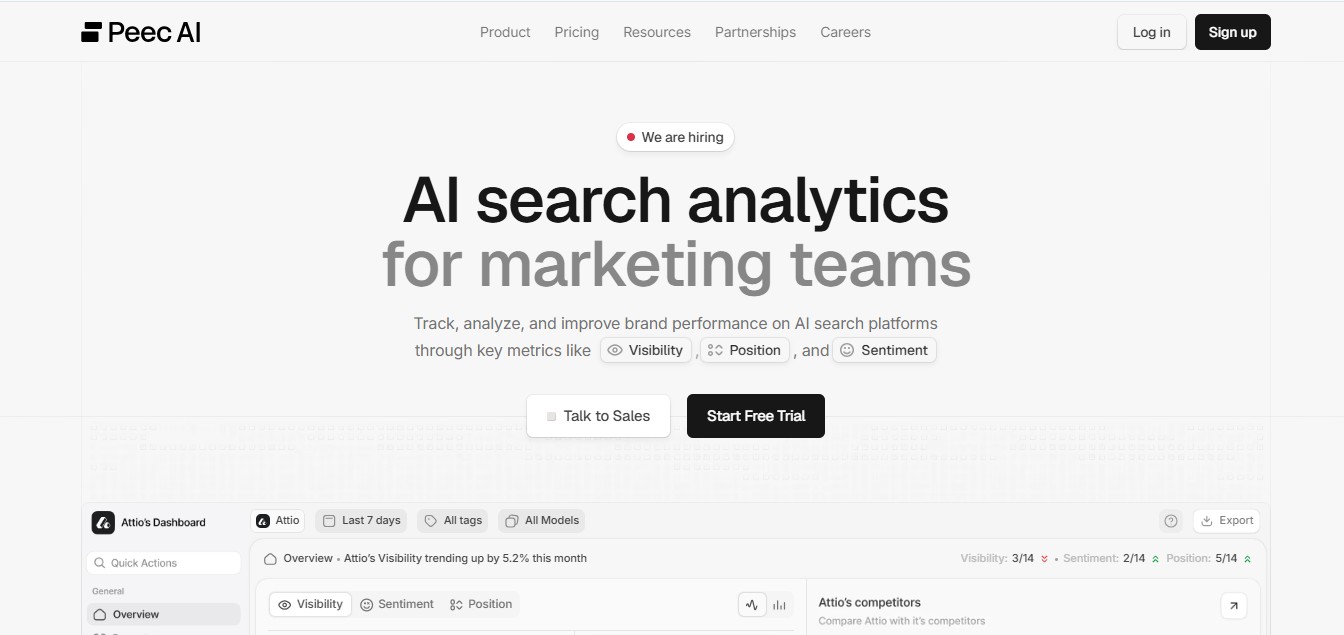
Daily Browser‑Based Tracking and Sentiment
Peec AI is a dedicated AI-search visibility tool that emphasizes straightforward tracking, clean dashboards, daily refreshes, citations, competitor comparisons, and sentiment. It is well suited to teams that want a focused monitoring product without the broader SEO-tool complexity of Semrush or Ahrefs.
Each public plan allows users to choose three AI models. The product tracks visibility by prompt and supports daily monitoring, which is helpful when comparing performance changes over time rather than treating one answer as definitive.
Agency‑Friendly Reporting and Unlimited Seats
A major advantage is unlimited users across Starter, Pro, and Advanced. This is important for agencies, in-house marketing teams, and distributed content teams that do not want extra per-seat charges.
Advanced adds multi-country tracking and Looker Studio integration. Its Enterprise tier includes custom prompts, unlimited projects, API access, SSO, daily or weekly tracking choices, and up to 12 tracked models.
Pricing and Limitations vs Enterprise Tools
| Peec AI plan | Annual-billing price | Monthly-billing equivalent | Main limit |
| Starter | $80/mo | $95/mo | 50 prompts, 1 project |
| Pro | $205/mo | $245/mo | 150 prompts, 2 projects |
| Advanced | $420/mo | $495/mo | 350 prompts, 5 projects |
| Enterprise | Custom | Custom | Custom prompts, all models, unlimited projects |
Peec AI is competitively priced for teams prioritizing core reporting. However, buyers should note the three-model limit on self-serve plans. A company needing broad engine monitoring, deep technical diagnostics, complex governance, or integrated workflow agents may need an Enterprise setup or another platform.
Best for: agencies and marketing teams that need clear multi-user reporting and predictable prompt-based pricing.
SE Ranking AI Search – Best Mid‑Market All‑in‑One SEO + AI Tracker
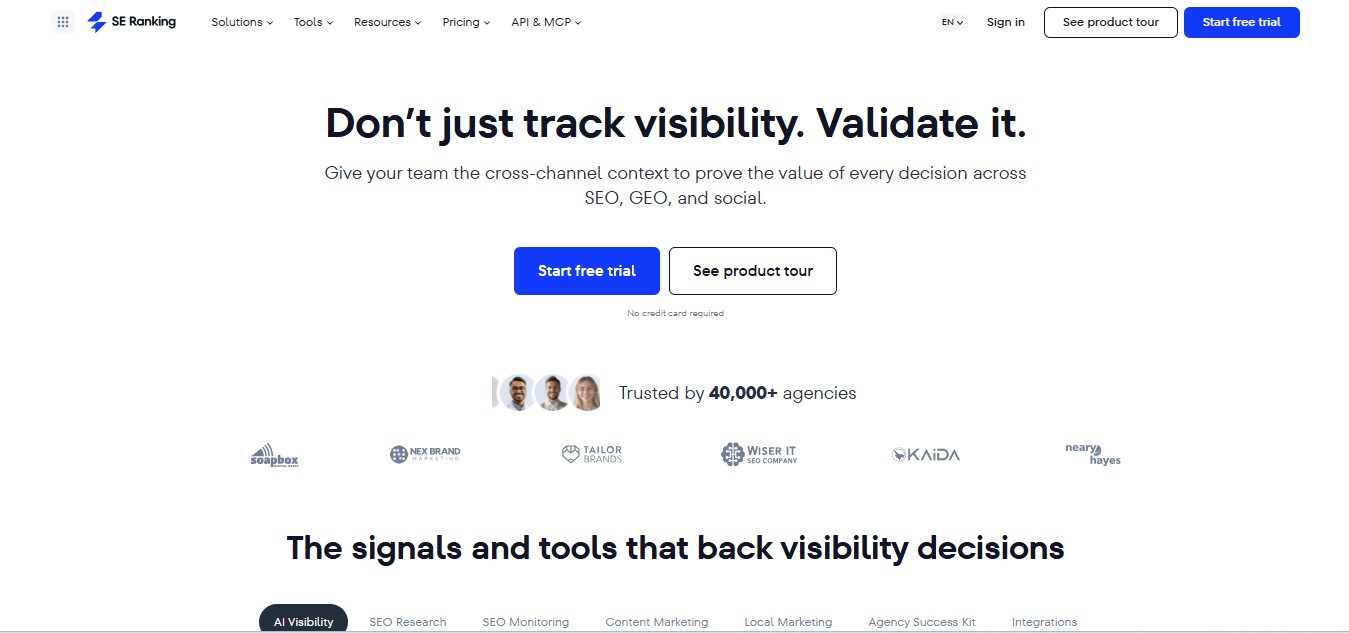
AI Results Tracker and Competitor Research
SE Ranking combines classic SEO capabilities with AI-result monitoring. It tracks brand mentions, citations, links, visibility, and competitive presence across ChatGPT, Gemini, Perplexity, Google AI Overviews, and Google AI Mode.
Its larger product stack includes rank tracking, keyword research, competitor research, backlinks, site auditing, reporting, API access, and MCP capabilities. This makes it a practical option for teams that want a consolidated SEO and AI-search workflow.
GA4/GSC Integration and Reporting
Core includes integrations with Data Studio, Matomo, Google Analytics, and Google Search Console. Growth adds historical data, guest links for collaboration, page-change monitoring, and dedicated customer support.
For agencies, the mix of multiple projects, daily keyword tracking, prompt tracking, audit capacity, API credits, and reporting makes SE Ranking attractive. The tool also works well for teams tracking prompts by content pillar or topic group.
Pricing and Scaling Considerations
| SE Ranking plan | Annual-billing price | Monthly list price | Main AI-search capacity |
| Core | $103.20/mo | $129/mo | 100 prompts tracked daily |
| Growth | $223.20/mo | $279/mo | 250 prompts tracked daily |
| Enterprise | Custom | Custom | Custom capacity |
Core includes 10 projects, 2,000 keywords, five GEO-research domains, 250,000 monthly audit pages, 25,000 API credits, and MCP access. Growth raises these limits substantially.
Some configurations may include or require a separate AI Search add-on. Readers should distinguish between the base SEO plan, AI Search add-on, and standalone AI visibility product before comparing total costs.
Best for: mid-market SEO teams and agencies that need a broad SEO platform with Gemini and multi-engine monitoring.
Surfer – Best for Content‑Led AI Visibility Optimization
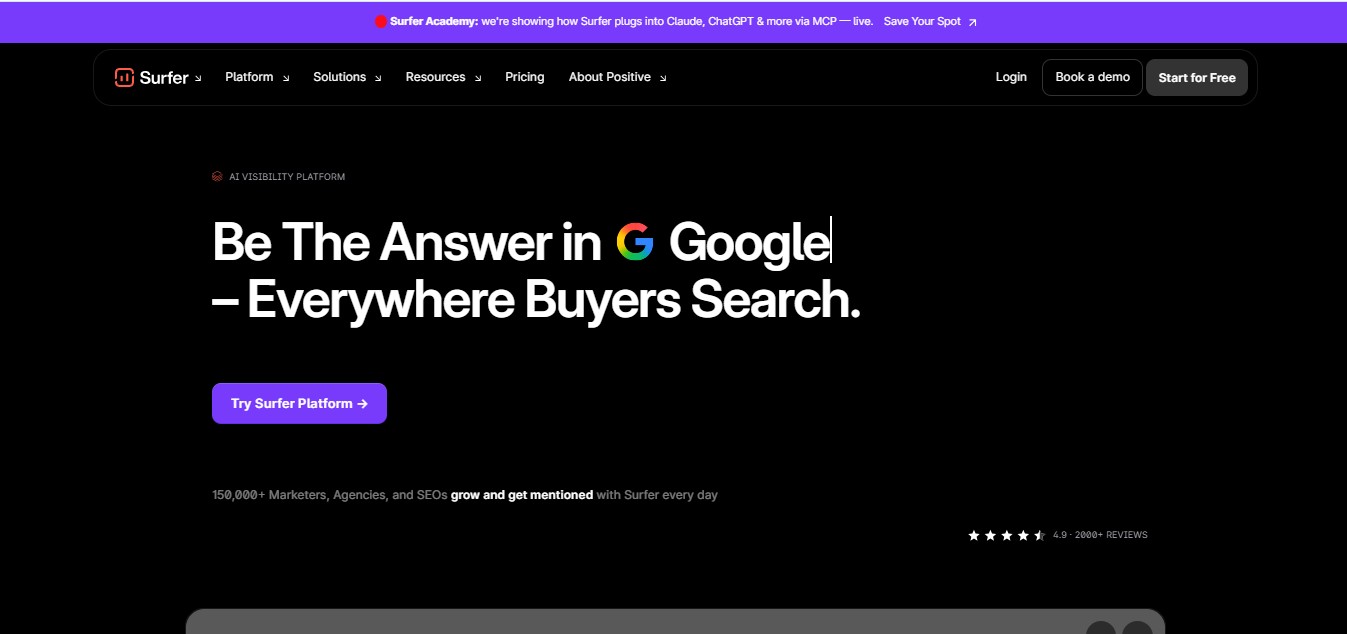
AI Search Insights and On‑Page Optimization
Surfer is best known as a content optimization platform, but its AI Search Analytics and AI Tracker capabilities make it relevant for Gemini visibility work. It tracks brand mentions, mention gaps, sentiment, sources, competitor citations, prompts, and time-series data, then turns those signals into recommendations.
This is valuable because visibility tracking has limited value if a content team cannot act on the findings. Surfer connects tracking with content creation, optimization, internal linking, briefs, content ideas, and brand knowledge.
Content Editor, Briefs, and Topic Clusters
Surfer’s content ecosystem includes:
- Content Editor for optimization during writing and revision
- AI Tracker for prompt, brand mention, and citation data
- Recommendations that prioritize topics, mentions, and sentiment issues
- Brand Knowledge to maintain consistent messaging
- Internal-linking assistance and content-planning workflows
- MCP support for bringing Surfer data into compatible agent workflows
For a publisher or SEO content team, this can shorten the path from “we are missing from Gemini answers” to “here is the page, brief, topic, and internal-linking work we should prioritize.”
Pricing and Content‑Team Fit
| Surfer plan | Price shown | AI prompt allowance |
| AI Search Analytics | $158/mo | 100 prompts, daily refresh |
| Standard | $99/mo | 25 prompts, weekly refresh |
| Pro | $182/mo | 50 prompts, daily refresh |
| Peace of Mind | $299/mo | 100 prompts, daily refresh |
| Enterprise | Custom | Custom limits |
AI Search Analytics works as a focused visibility product, while Standard and Pro bundle content-production features with lower prompt allowances.
Best for: content-focused businesses that want visibility tracking to directly inform briefs, optimization tasks, internal links, and editorial calendars.
Rankscale – Best for Technical SEO Teams Diagnosing AI Discoverability
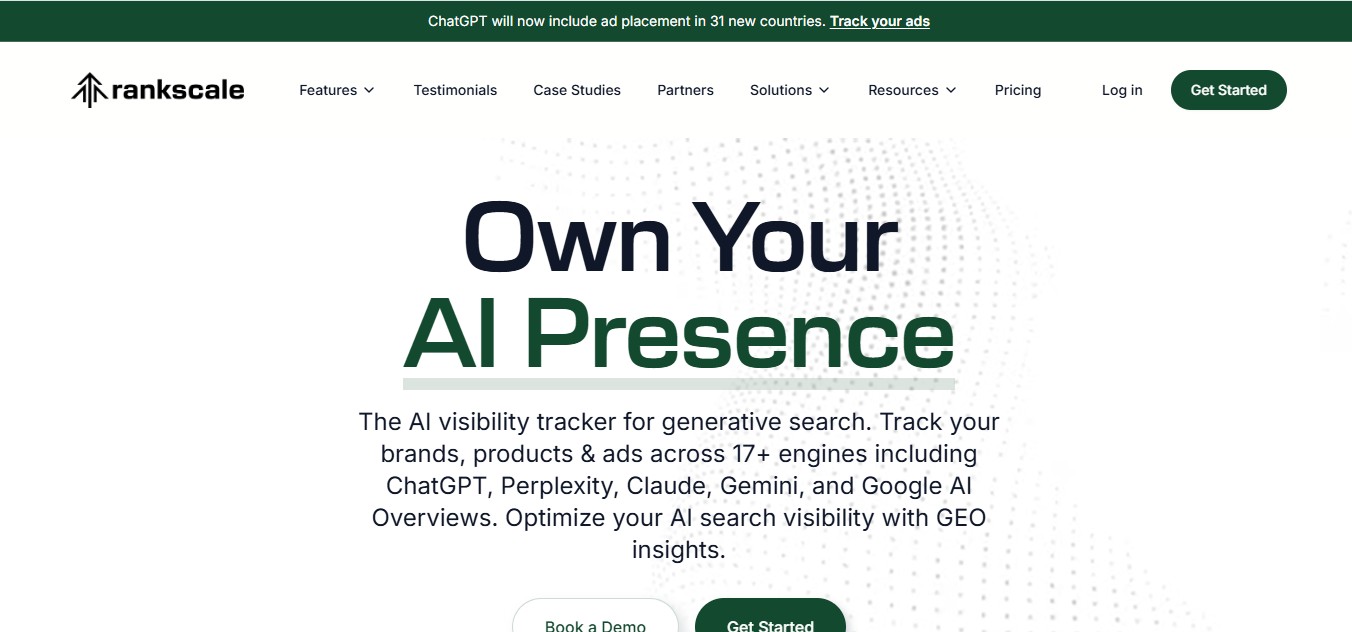
Crawl, Log, and Indexation Diagnostics for AI
Rankscale offers broad coverage across 17+ AI engines, including ChatGPT, Gemini, Claude, Perplexity, Google AI Overviews, Mistral, Grok, DeepSeek, and others. It also provides page-level readiness audits designed to assess how well a URL can be retrieved and used by AI systems.
Its strength lies in coverage breadth and flexible sampling. Rather than locking teams into a small number of models, Rankscale uses a credit system that can be allocated according to the engines and queries that matter most.
Citation Analysis and AI Campaign Tracking
Rankscale monitors:
- Brand mentions and prominence
- Competitor appearances
- Citation sources and cited URLs
- Sentiment
- Page-level AI readiness
- Visibility by engine, prompt, and region
- Citation gaps for content and digital PR planning
This creates a useful technical workflow: monitor prompts, identify cited URLs, run page audits, improve content clarity and crawlability, and then monitor whether citations and prominence improve.
Enterprise Fit and Pricing Model
| Rankscale plan | Price shown | Included credits | Approximate response capacity |
| Essentials | From $20/mo | 120 credits | Varies by selected engines |
| Pro | $99/mo | 1,200 credits | Up to 4,800 answers |
| Growth | $385/mo | 5,500 credits | Up to 22,000 answers |
| Enterprise | $780/mo | 12,000 credits | Up to 48,000 answers |
The higher plans provide white-label options, REST API availability, larger brand-dashboard limits, page audits, unlimited search terms, and global region access.
The trade-off is that buyers must understand credit consumption. A $99 plan can be cost-effective for selective monitoring across multiple engines, while a fixed-prompt plan may be easier for stable reporting needs.
Best for: technically capable marketers and agencies that need broad model coverage, citation-level data, and AI-readiness audits.
HubSpot AEO – Best Entry‑Level Tracker for CRM‑Aligned Teams
Visibility Metrics and CRM‑Informed Recommendations
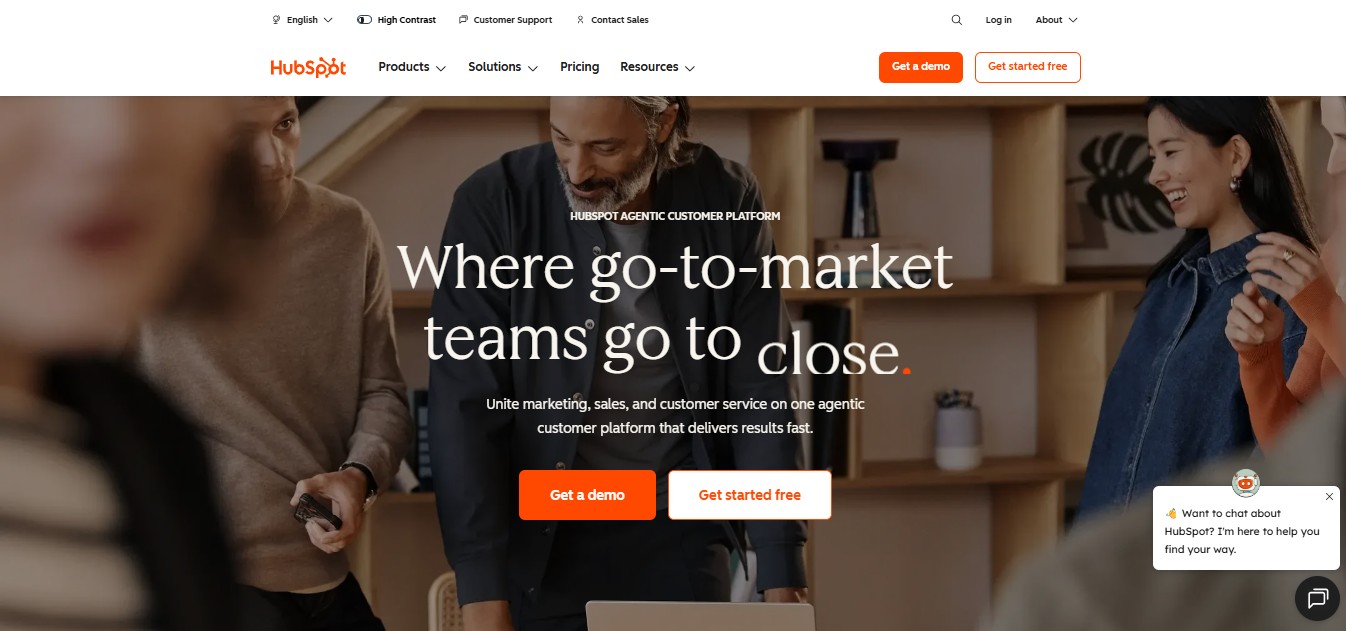
HubSpot AEO is a standalone tracking product and a feature connected with broader HubSpot marketing plans. It tracks brand visibility, sentiment, share of voice, full responses, citations, and competitors across ChatGPT, Gemini, and Perplexity.
Its key differentiator is CRM context. Teams can identify and prioritize prompts based on customer questions, buyer journeys, content demand, product relevance, and campaign activity.
It is not designed as a complete replacement for a specialist technical tracker. Its value is strongest when a company already runs marketing, contacts, content, campaigns, and attribution through HubSpot.
Citation and Competitor Analysis
HubSpot AEO supports:
- Brand visibility scoring
- Competitor share of voice
- Prompt-level response analysis
- Citation analysis by domain, page, source type, and content type
- Sentiment analysis
- Prompt suggestions aligned with buyer journeys
- Recommendations for content updates, social content, or third-party coverage
HubSpot also provides AI-search trend research that can help teams understand broader industry-level visibility and citation patterns.
Standalone vs Marketing Hub Pricing
HubSpot AEO is available as a standalone product at approximately $50 per month in some configurations. It is also connected to broader HubSpot pricing.
The screenshot shows general HubSpot platform pricing in Indian rupees:
| HubSpot plan | Price shown |
| Free | ₹0/mo |
| Starter | ₹585/mo per seat |
| Professional | ₹66,697/mo |
| Enterprise | ₹300,000/mo |
These figures refer to HubSpot’s wider marketing and customer platform, not only its AI visibility product.
Best for: teams already invested in HubSpot that want AI-answer visibility tied to CRM, campaign, and lifecycle data.
LLMrefs – Best for Unified Google AI + Search + Shopping Intelligence
Keyword‑Scoped AI Visibility and Shopping Context
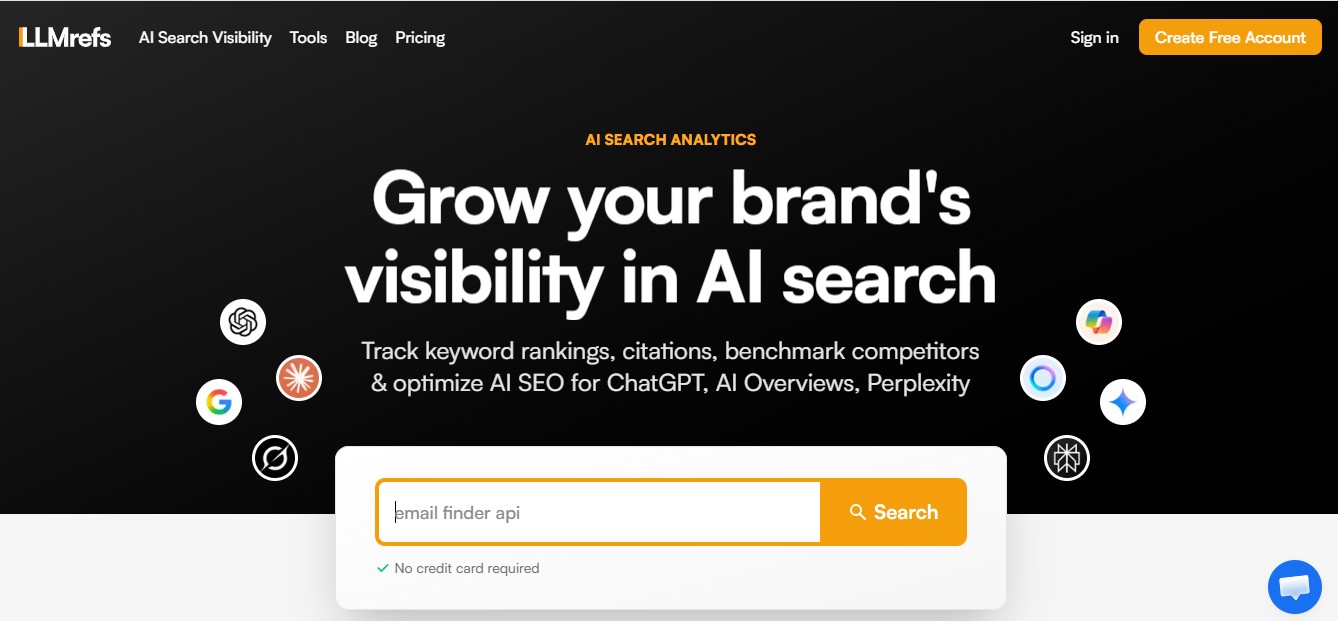
LLMrefs is an AI-search analytics platform that turns target keywords into conversation-style prompts and monitors mentions, citations, source URLs, positions, competitors, and share of voice across supported engines.
One practical feature is automatic prompt generation from keywords. This helps a content marketer move from a keyword list to a relevant conversation set, such as:
- “What is the best email marketing tool for ecommerce?”
- “Which email platforms integrate with Shopify?”
- “What are the best affordable email marketing tools?”
- “Best alternatives to [competitor] for small businesses?”
Enterprise Deployment and Support
The All-in-One plan includes 500 prompts, weekly visibility reports, citation tracking, country and language targeting, unlimited projects, unlimited team members, CSV export, API access, and priority support.
The platform also includes crawlability checks, a Reddit threads finder, an llms.txt generator, and other AI SEO tools.
When to Choose LLMrefs Over Pure AI Trackers
Choose LLMrefs when prompt volume, geographic coverage, unlimited projects, and straightforward pricing matter more than complex enterprise controls. The $79 monthly plan offers 500 prompts and multi-country support, making it a strong value option for agencies and teams working across several domains.
Best for: small-to-mid-sized marketing teams that need broad prompt tracking, multi-country coverage, and predictable flat-fee pricing.
Otterly.ai – Best Budget‑Friendly Starting Point with Enterprise Tier
Multi‑Engine Monitoring and Looker Studio Reporting
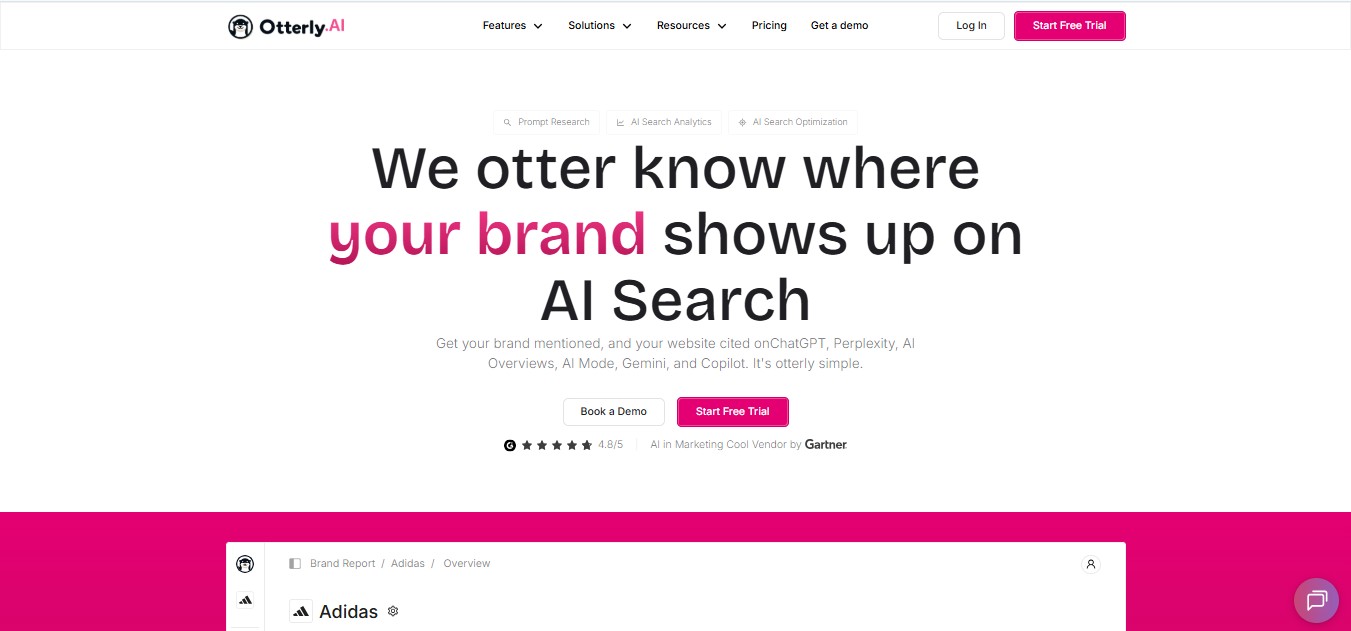
Otterly.ai is a dedicated visibility tracker for ChatGPT, Google AI Overviews, Perplexity, and Microsoft Copilot. It provides daily tracking, brand visibility reporting, citation data, recommendations, GEO URL audits, and ChatGPT Ads tracking.
Gemini, Claude, and Google AI Mode are available as additional engine options rather than standard base-engine coverage. This matters when comparing its headline pricing against tools that include Gemini from the first plan.
Its Standard plan includes Looker Studio, which is useful for consultants and agencies building client dashboards.
Unlimited Seats and Agency Workflows
The visible Otterly.ai plans include unlimited team members. Standard provides 100 prompts, unlimited workspaces, unlimited recommendations, 5,000 GEO URL audits monthly, Looker Studio, API access, MCP access, and agent analytics. Premium increases prompt capacity to 400 and raises API/MCP usage limits.
Pricing and Security Considerations
| Otterly.ai plan | Price | Prompt allowance |
| Lite | $29/mo | 15 prompts |
| Standard | $189/mo | 100 prompts |
| Premium | $489/mo | 400 prompts |
| Enterprise | Custom, from $1,000/mo | Custom prompts and terms |
The Enterprise tier adds customizable prompt tracking, SSO, custom payment options, quarterly GEO health checks, personalized onboarding, and a dedicated customer success manager.
Best for: small teams, agencies, and consultants that want daily monitoring and audits at a low entry price, while understanding that Gemini may require an add-on.
Final Verdict
The right tracker depends on whether your biggest need is large-scale market intelligence, technical AI readiness, CRM integration, content execution, or basic answer monitoring.
- Choose Semrush or Ahrefs Brand Radar when you already operate inside these SEO ecosystems and need broad research data.
- Choose Profound, AthenaHQ, or Scrunch when you have enterprise requirements around broad coverage, governance, technical diagnostics, specialized research, or executive reporting.
- Choose Surfer when the main objective is using visibility data to guide content creation, optimization, briefs, and internal links.
- Choose SE Ranking or Nightwatch when you want conventional rank tracking and AI visibility in one SEO reporting stack.
- Choose Peec AI, LLMrefs, or Otterly.ai when clear monitoring, collaborative reporting, or lower entry costs are the priority.
- Choose Rankscale when broad engine coverage and page-level readiness audits are more important than fixed prompt pricing.
For most brands, Radarkit is the best overall alternative to choose. It combines Gemini and multi-engine visibility tracking with location coverage, competitor and citation research, Google Search Console integration, and practical agents for content, outreach, Reddit research, and workflow support.
Radarkit also has a clear price-to-function advantage. Its $29 Lite plan provides an accessible entry point, Growth at $79 adds daily tracking and 50 prompts, and Pro at $139 supports multi-project monitoring. For enterprise teams, it offers custom prompts, 70+ locations, API access, SSO, unlimited seats, and dedicated support.
That does not mean Radarkit is the best platform for every single case. Ahrefs can be stronger for massive market research, Profound for governed enterprise programs, Scrunch for technical agent-readiness work, and Surfer for content-production teams. However, Radarkit is the most balanced choice for brands that want to measure Gemini visibility and act on the findings without assembling several separate tools.
FAQ
What is a Gemini visibility tracker?
A Gemini visibility tracker monitors whether a brand, product, website, or competitor appears in responses generated by Google Gemini. Depending on the platform, it can track mentions, citations, answer position, share of voice, sentiment, source domains, and visibility changes over time.
Does Gemini visibility replace traditional SEO tracking?
No. Traditional SEO still measures organic rankings, impressions, clicks, technical health, backlinks, and search demand. Gemini visibility monitoring adds another layer: whether a brand appears in answer-based discovery experiences. The best workflow compares both data sets instead of replacing one with the other.
Which metrics should brands track first?
Start with:
- Brand mention rate
- Citation rate
- Share of voice against direct competitors
- Answer position or prominence
- Sentiment and accuracy of brand descriptions
- Source domains and cited pages
- Prompt intent, such as informational, comparison, commercial, or local
- Geographic and language differences
A meaningful report should preserve the prompt, engine, date, location, full response, cited URLs, and competitors shown in the answer.
How many prompts should a brand monitor?
A useful starting point is 25 to 50 prompts for one brand or product category. Mature programs often track 100 to 500 prompts across multiple categories, regions, and buyer personas. The ideal number depends on the size of the product catalog, number of markets, and frequency of new content or campaigns.
How often should Gemini prompts be refreshed?
Daily tracking is best for brands running active campaigns, competitive categories, fast-moving launches, or agency client reporting. Weekly tracking is enough for early-stage programs and strategic benchmarking. Avoid making decisions from a single response; look for trends across multiple refreshes.
Are citations more important than mentions?
They measure different things. A mention shows that the brand has entered the answer. A citation shows that a page or domain is treated as a source. The strongest outcome is a positive, prominent mention supported by an accurate citation to an owned page or authoritative third-party source.
Can these tools guarantee better visibility in Gemini?
No legitimate platform can guarantee placement in Gemini or any other answer engine. These tools identify gaps, competing brands, citation patterns, content opportunities, and technical issues. Results still depend on the usefulness, accuracy, authority, accessibility, and reputation of the brand’s content and third-party references.
Is Radarkit suitable for agencies?
Yes. Radarkit’s Pro plan supports 10 projects and 100 prompts, while Enterprise adds unlimited projects, unlimited seats, custom tracking, API access, SSO, and 70+ locations. Its integrated reporting and execution agents also make it suitable for agencies that need to turn analysis into content and outreach tasks.
