

Profound vs Otterly vs Peec AI is a useful comparison for marketing teams that want to measure how their brand appears in AI search results. All three platforms track brand visibility, citations, competitors, and prompt performance, but they approach the work differently.
Profound is built around AI search intelligence and marketing agents. OtterlyAI connects prompt research, monitoring, page audits, and optimization. Peec AI keeps the experience centered on visibility, position, sentiment, and source analysis. Profound vs Otterly vs Peec AI the best option depends on whether your team needs enterprise workflows, content-focused diagnostics, or clear reporting.
This guide compares Profound vs Otterly vs Peec AI across 12 important areas. It also explains why Radarkit is worth considering for teams that want broad AI platform tracking, citation research, local visibility reporting, and built-in tools to turn findings into content and outreach work.
Profound vs Otterly vs Peec AI: Quick Comparison
| Feature | Profound | OtterlyAI | Peec AI |
| Main focus | AI search intelligence and marketing agents | AI search monitoring, content intelligence, and GEO optimization | AI search analytics and reporting |
| Starting price | Free Trial for brands, Agency Growth from $99/month plus add-ons | $29/month | $95/month |
| Free trial | Yes, free Trial plan | Yes, 7-day trial | Check current onboarding options |
| Prompt capacity | 10 prompts on Trial, custom Enterprise plans | 15 to 400 prompts on public plans | 50 to 350 prompts on public plans |
| Tracking frequency | One-time Trial run, daily on Enterprise | Daily | Daily |
| Core AI platforms | ChatGPT on Trial, up to 9 answer engines on Enterprise | ChatGPT, Google AI Overviews, Perplexity, Copilot, plus optional Claude, Gemini, and AI Mode | Choose 3 models on standard plans, all models on Enterprise |
| Brand visibility | Yes | Yes | Yes |
| Brand position | Yes | Yes | Yes |
| Sentiment analysis | Yes | Yes | Yes |
| Citation tracking | Yes, including detailed citation analysis | Yes, including linked pages and cited domains | Yes, including source discovery and recommendations |
| Competitor tracking | Yes | Yes | Yes |
| Content recommendations | Yes, through agents, briefs, and audits | Yes, through GEO audits, content audits, and briefs | Yes, through source-based recommendations |
| API access | Enterprise | Standard and above | Enterprise and selected higher-tier access |
| Looker Studio | Not the primary public reporting option | Standard and Premium | Advanced and higher tiers |
| Agency support | Dedicated agency plans | Agency workflows and partner program | Multiple projects and client reporting |
| Best fit | Enterprise marketing teams and agencies needing agent workflows | Content marketers and teams focused on optimization | Teams that want clear AI search reporting |
12 Differences in Features, Pricing and Tracking
1. Overall Positioning and Target Users
Who is Profound best for?
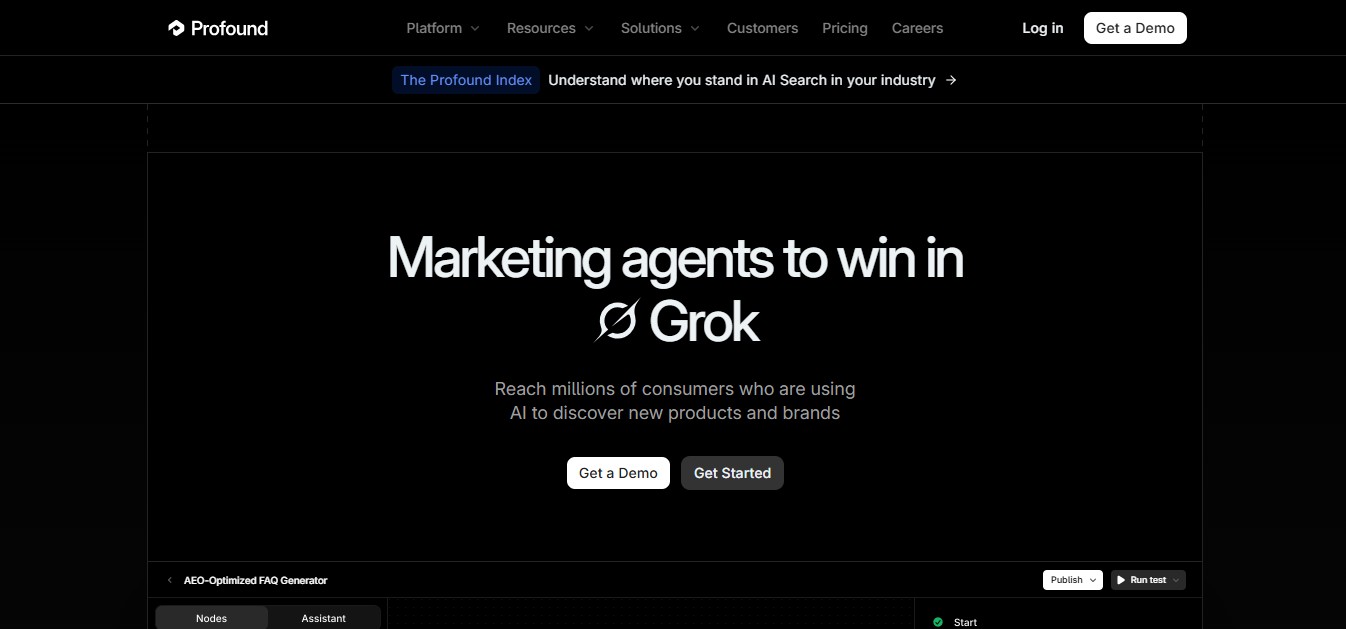
Profound is best suited to enterprise brands, larger marketing teams, and agencies with complex AI search programs. Its positioning extends beyond brand monitoring because it includes an AI Marketer, reusable agent templates, content briefs, page improvement workflows, prompt-volume insights, context management, and agent analytics.
A team that already has writers, SEO specialists, PR support, and internal approval processes can use Profound to connect research, production, measurement, and reporting. It is especially relevant for companies that want one platform to support larger-scale AI search work.
Profound also has a dedicated agency pricing path. Agency Growth starts at $99 per month plus add-ons and includes pitch workspaces, Agency Mode, and consolidated billing. Full client workspaces are listed as a $399 monthly add-on.
Who is Otterly best for?
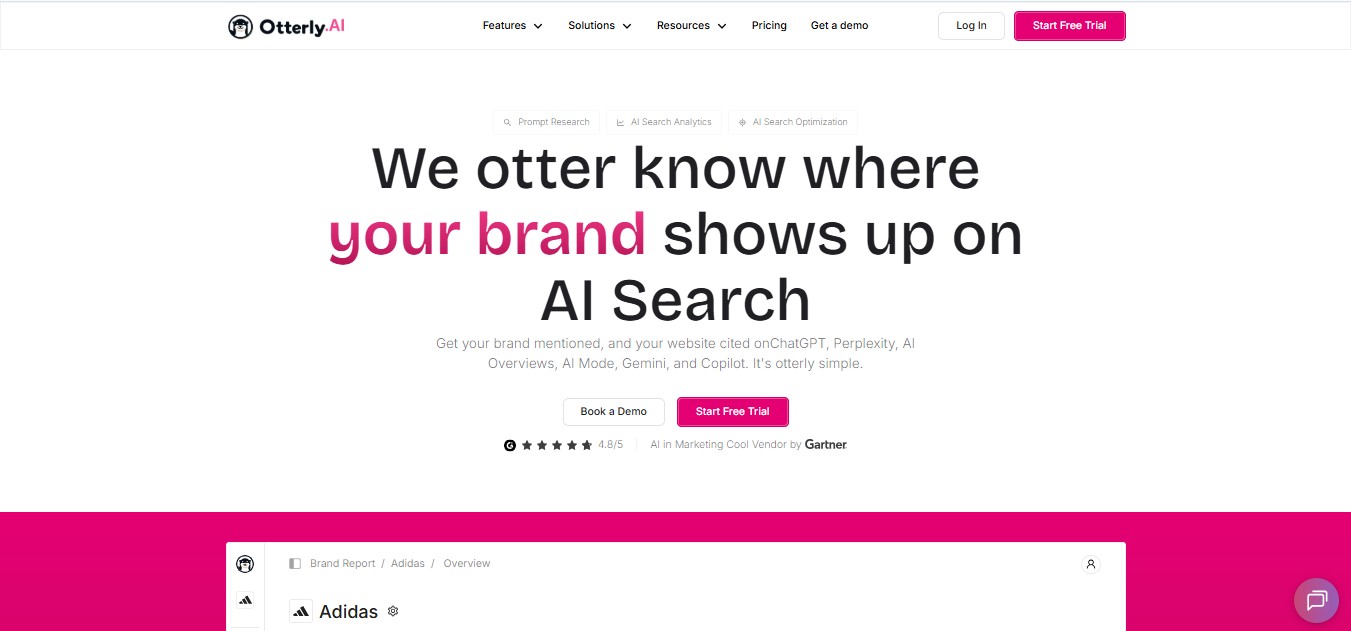
OtterlyAI is a strong fit for content marketers, SEO teams, consultants, and agencies that want to understand why a page or brand is missing from AI-generated answers. Its product is organized around prompt research, monitoring, source analysis, crawlability checks, AI-readiness checks, content audits, prediction, briefs, and GEO recommendations.
OtterlyAI is useful for teams that want a practical question-and-answer workflow:
- Which prompts matter in our category?
- Does ChatGPT, Perplexity, Gemini, or Google AI Overviews mention us?
- Which sources are cited instead?
- Can AI search engines crawl our pages?
- What should we improve on the page or in off-site coverage?
This makes OtterlyAI a natural choice for teams that want to connect AI visibility reporting to editorial, SEO, PR, and content improvement tasks.
Who is Peec AI best for?
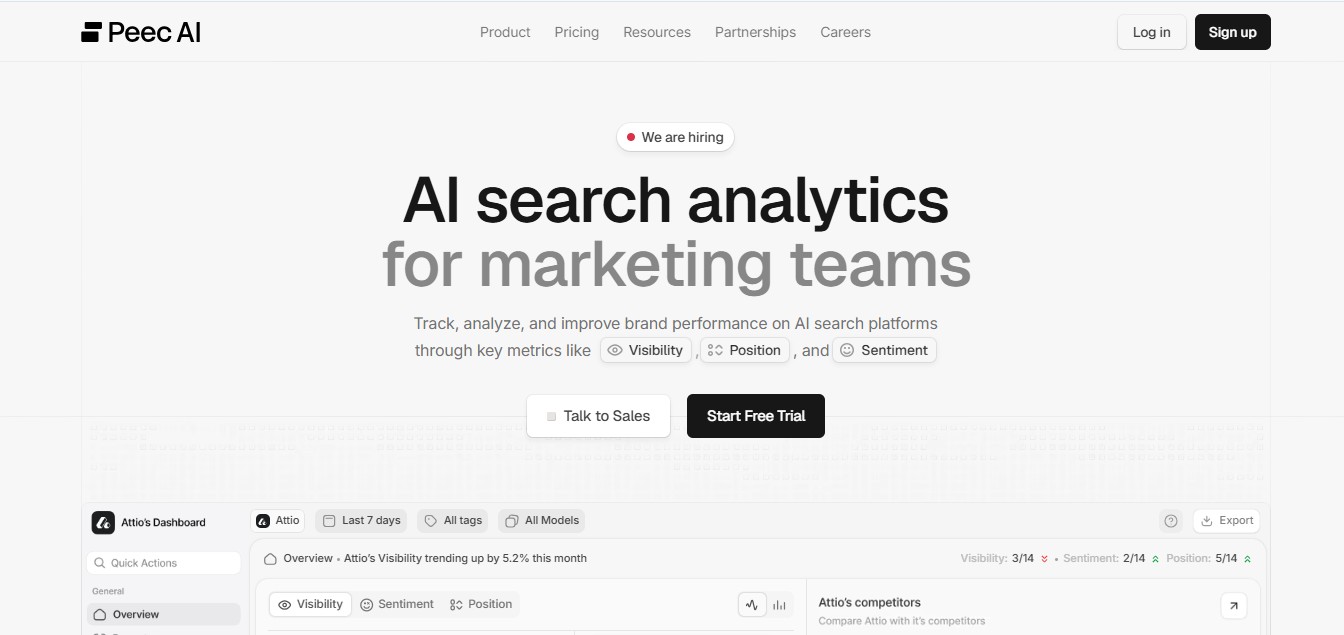
Peec AI is best for marketing teams that want a focused analytics product for AI search. Its core measurements are visibility, position, sentiment, competitor performance, prompts, and cited sources.
The platform keeps the workflow simple. You add prompts, organize them with tags, select models and markets, compare brands, inspect sources, and use the results to decide what to publish or where to build a presence.
Peec AI is particularly suitable for teams that want reporting clarity without requiring a large collection of additional marketing tools. Its dashboard provides a direct view of how frequently a brand is named, how prominently it appears, and how positively it is described.
Which tool is easiest for smaller teams?
For smaller teams, OtterlyAI has the lowest-cost public entry point among these three products at $29 per month. Its Lite plan includes 15 search prompts, daily tracking, unlimited team members, and four core AI search engines.
Peec AI can also be easy to learn because its reporting focuses on a few understandable metrics: visibility, position, and sentiment. Its Starter plan begins at $95 per month and includes 50 prompts, three selected models, unlimited users, daily tracking, and one project.
Profound’s free Trial is helpful for a limited evaluation, but it runs 10 prompts once and tracks ChatGPT only. It is more appropriate for a product test than a long-term monitoring program.
For small teams that need lower pricing but also want content, outreach, reporting, local visibility, and broader model coverage in one place, Radarkit offers a different route. Its Lite plan costs $29 per month, includes two projects, 15 prompts, six listed AI platforms, 50+ locations, AI traffic analytics, and access to multiple agents.
2. AI Search Engines and Models Supported
Profound’s AI engine coverage
Profound’s free Trial covers ChatGPT only. Its Enterprise plan supports up to nine answer engines, depending on the package. These include ChatGPT, Perplexity, Google AI Mode, Gemini, Microsoft Copilot, Grok, DeepSeek, Claude, and Google AI Overviews.
Profound treats platforms separately. For example, it distinguishes between Gemini, Google AI Mode, and Google AI Overviews rather than grouping all Google AI surfaces under one label. This matters because a brand can perform differently on each answer engine.
Profound also supports visibility tracking for Exa, which powers a number of AI agents and coding tools. This gives Enterprise customers another channel for studying how their brand appears in agent-driven search experiences.
Otterly’s AI engine coverage
OtterlyAI tracks ChatGPT, Google AI Overviews, Perplexity, and Microsoft Copilot on its standard plan setup. Google AI Mode, Gemini, and Claude are available as add-ons.
Its product pages also position the platform around monitoring ChatGPT, Perplexity, Google AI Overviews, Google AI Mode, Gemini, Copilot, and Claude. This makes OtterlyAI practical for teams that care about both Google-based AI experiences and major conversational platforms.
The add-on structure is important when comparing total costs. A Lite plan may look inexpensive at $29 per month, but the price changes if a team also needs Google AI Mode, Gemini, or Claude tracking.
Peec AI’s AI engine coverage
Peec AI lets customers choose three AI models on Starter, Pro, and Advanced plans. Enterprise users can choose all supported models, with the pricing page listing up to 13 tracked LLM models.
Peec AI publicly emphasizes performance tracking across ChatGPT, Perplexity, and Gemini. Its model selection approach is useful for teams that want to focus spending on the platforms that matter most to their audience.
The trade-off is that model coverage depends on plan configuration. A team should decide which platforms matter before choosing a plan, rather than assuming that every model is included by default.
Which platform offers the broadest tracking coverage?
Profound offers the broadest potential answer engine coverage among the three when a company chooses Enterprise. Its Enterprise plan lists up to nine answer engines, along with separate tracking for multiple Google surfaces.
OtterlyAI provides solid coverage across major AI search platforms but treats Claude, Gemini, and Google AI Mode as paid add-ons. Peec AI provides flexible model selection, with three models on public plans and all available models on Enterprise.
For teams that want six major AI platforms included on fixed monthly plans, Radarkit tracks ChatGPT, Google AI Mode, Google AI Overviews, Microsoft Copilot, Perplexity, and Gemini.
3. Prompt Tracking and Monitoring Limits
How Profound handles tracked prompts
Profound uses prompts as the base layer of its Answer Engine Insights product. The free Trial includes 10 prompts that run once. Enterprise customers receive a tailored prompt tracking plan, daily tracking, custom regions, custom languages, unlimited projects, and historical data access.
Profound also offers Prompt Volumes, which uses a large dataset of real user conversations to help teams understand demand patterns and question topics. This can help teams decide which buyer questions deserve monitoring or content investment.
Its prompt analysis can include filters for region, platform, persona, topics, tags, cited domains, and cited pages. That depth is valuable for mature teams with large prompt libraries.
Otterly prompt limits by plan
OtterlyAI has easy-to-understand public prompt limits:
| OtterlyAI plan | Search prompts | Tracking frequency |
| Lite | 15 | Daily |
| Standard | 100 | Daily |
| Premium | 400 | Daily |
| Enterprise | Custom | Custom |
Standard and Premium customers can add 100 extra monthly prompts for $99. Lite customers do not have this add-on option listed.
The Lite plan is practical for a narrow set of branded and category prompts. The Standard plan is more suitable when a business needs to cover product categories, buyer questions, competitor terms, use cases, and markets.
Peec AI prompt limits by plan
Peec AI offers higher starting prompt capacity than OtterlyAI, but at a higher entry price.
| Peec AI plan | Prompts | Models | Projects | Tracking frequency |
| Starter | 50 | Choose 3 | 1 | Daily |
| Pro | 150 | Choose 3 | 2 | Daily |
| Advanced | 350 | Choose 3 | 5 | Daily |
| Enterprise | Custom | All models | Unlimited | Daily or weekly |
Peec AI also includes prompt tags, AI-suggested prompts, and search-volume information to help teams group prompts by topic, intent, funnel stage, or category.
A 50-prompt Starter plan can work well for a brand that wants to track its top buyer questions in a single market. The Pro and Advanced plans are better suited to larger content programs or multi-client teams.
Which tool gives you the most tracking capacity?
At the highest public plan between Profound vs Otterly vs Peec AI, OtterlyAI Premium tracks 400 prompts. Peec AI Advanced tracks 350 prompts. Both platforms offer custom Enterprise capacity beyond those limits.
Profound does not publish prompt quantities for Enterprise because plans are tailored. Its approach makes sense for organizations with unique tracking needs, but it makes a direct cost-per-prompt calculation harder before speaking with sales.
For teams that want fixed pricing below $150 per month, Radarkit provides 15 prompts for $29, 50 prompts for $79, and 100 prompts for $139. Its Lite plan refreshes every 72 hours, while Growth and Pro plans refresh daily.
4. Brand Visibility and Mention Tracking
Profound’s brand visibility reporting
Profound measures whether a brand appears in answer engine responses, how it is described, where it is cited, and how it compares with competitors. Its Brand Health reporting tracks visibility, citation share, sentiment, and brand accuracy for the topics a team wants to own.
The platform also supports page-level views. Its Pages feature crawls a site through sitemap discovery and surfaces pages alongside their AI citation status and bot crawl activity. This can help a marketing team identify pages that have not earned citations yet.
Profound’s view is especially helpful when an organization wants to combine prompt data with content workflows, crawler activity, referral traffic, and agent-assisted work.
Otterly’s Brand Visibility Index
OtterlyAI uses a Brand Visibility Index to show whether a brand is appearing across tracked AI search answers. It also tracks brand mentions, competitor mentions, source links, citations, and share of AI voice.
OtterlyAI’s visibility reporting presents coverage as the top-level KPI, with citations serving as the diagnostic layer that helps explain why a brand is or is not appearing.
This is a clear approach for content teams. A team can first ask, “Are we showing up?” Then it can use citations, source analysis, prompt data, and recommendations to find practical next steps.
Peec AI’s visibility scores
Peec AI measures visibility as the share of chats where a brand appears. It pairs this metric with average position and sentiment, giving teams three core signals on a single dashboard.
For example, a business may have high visibility but appear low in an answer’s brand list. Another company may show up less frequently but receive stronger sentiment when it does appear. Peec AI’s reporting makes it easier to separate these situations.
Its brand comparison features help teams assess their performance against competitors across selected prompts, models, markets, and time periods.
Which platform makes visibility easiest to understand?
Peec AI is arguably the simplest starting point for visibility reporting because it keeps attention on visibility, position, and sentiment. The interface is built around making these metrics easy to compare across brands.
OtterlyAI is also accessible for teams that want a direct top-line coverage measure paired with practical diagnostics. Profound gives more detailed intelligence, but it may be most valuable to teams prepared to use that depth across content, agent workflows, analytics, and reporting.
5. Citation and Source Tracking
How Profound tracks citations
Profound offers detailed citation analysis through Answer Engine Insights. It can show which pages are cited, which passages from a page are quoted, and how those citations connect to referral traffic and crawler activity.
Its citation views can categorize sources as owned properties, competitors, earned media, PR wire services, social sites, and institutional sources. That grouping helps teams see whether visibility depends mainly on their own content, external media coverage, community discussions, reviews, or authoritative publications.
Profound also includes YouTube Citation Breakdown. This feature organizes cited YouTube channels, individual videos, and video categories, which is useful for brands with video-heavy search behavior.
Otterly’s cited-page analysis
OtterlyAI monitors citations and the linked pages that AI search platforms reference. It helps teams identify which websites and page types AI search platforms choose as sources for specific prompts.
Its citation workflow goes beyond owned content. OtterlyAI helps teams study sources such as PR coverage, earned media, Reddit, Wikipedia, social platforms, review sites, and other external domains that appear frequently in answers.
The platform also includes crawlability checks, AI-readiness audits, Content Audit and Prediction, and content briefs. These tools aim to show whether a brand’s own page can be crawled, understood, and considered for citation.
Peec AI’s source and citation reports
Peec AI helps users identify sources shaping visibility across tracked prompts. It can show cited domains, surface recurring source patterns, and recommend actions based on the websites and content types that frequently appear in answers.
For example, if review platforms appear frequently for product-comparison prompts, Peec AI may highlight the value of maintaining an updated review profile. If LinkedIn, Reddit, editorial publications, or community discussions appear repeatedly, the product can point teams toward relevant off-site participation or digital PR opportunities.
Peec AI’s source reports are designed for marketing teams that want to convert citation data into content, reputation, partnership, or PR tasks.
Which tool is best for finding citation opportunities?
Profound vs Otterly vs Peec AI, Profound offers especially deep citation analysis for enterprise teams that need passage-level and source-category detail. Its YouTube citation reporting also adds value for video publishers and brands that want to study non-text citation patterns.
OtterlyAI is strong for teams that want to pair citation findings with page audits, crawlability checks, and content changes. Peec AI is useful for a clear source-to-action workflow, especially when teams want to understand which external sources influence AI answers.
Radarkit is a strong alternative for teams that want citation analysis tied directly to content types, citation share, citation rank, unique cited URLs, competitor backlink opportunities, content generation, outreach, and Reddit research. It also shows which source formats, such as listicles, reviews, guides, forums, or product pages, are appearing in AI citations.
Competitor tracking in Profound
Profound compares a brand with competitors across tracked prompts and answer engines. It can show where competitors are visible, which pages or sources receive citations, and where your brand is missing from the answer.
For teams building larger content programs, this can help turn competitor visibility into a practical editorial plan. If a competitor earns citations from a particular guide format, topic cluster, comparison page, or media source, the team has evidence to investigate the gap.
Profound’s prompt, source, and citation intelligence can also feed into agent workflows. This allows a team to turn a visibility gap into a research task, a brief, a draft, or a reporting item.
Competitor comparison in Otterly
OtterlyAI supports competitor monitoring through brand visibility, share of AI voice, domain ranking, citations, and prompt-level reporting. It helps teams see when competitors are named, cited, or positioned more prominently on the same questions.
A useful workflow is to build a prompt set around buyer intent. For example, a project-management SaaS company could track prompts such as:
- Best project management software for remote teams.
- Best collaboration tools for agencies.
- Affordable task management tools for small businesses.
- Alternatives to a specific competitor.
- Project management tools with automation.
OtterlyAI can then show which brands and sources appear most often across that intent group.
Peec AI supports brand benchmarking across selected competitors. Its reporting pairs visibility, position, sentiment, and share-of-voice comparisons, helping teams see who leads a category in AI-generated answers.
The product’s brand matrix can be useful for identifying different competitive patterns:
- A brand with high visibility and strong sentiment.
- A competitor that appears frequently but ranks lower.
- A smaller company with a limited mention rate but high average position.
- A market leader with broad coverage across multiple models.
This lets teams make better decisions than simply checking whether their company was mentioned once or twice.
Which platform is best for competitive research?
Profound is well suited to deeper enterprise research because its competitor analysis connects to source intelligence, page-level citation status, prompt data, and agent workflows. OtterlyAI is useful for practical SEO and content comparisons that lead to prompt, page, and source-level action.
Peec AI is particularly easy to use for high-level competitor benchmarking because its visibility, position, and sentiment metrics sit together. Radarkit adds another option for teams that want competitors, share of voice, citations, local rankings, query fanout, traffic data, and content or outreach actions in a single workflow.
7. Sentiment and Brand Perception Analysis
Profound’s sentiment insights
Profound includes sentiment and brand accuracy in its AI search reporting. This means the platform can help teams evaluate not only whether a brand is mentioned, but also whether it is represented correctly and favorably in answer engine responses.
This is useful for companies with complex products, regulated claims, multiple product lines, or a heavy dependence on brand trust. A business may appear often in AI answers but still need to correct incorrect descriptions, missing product context, or outdated claims.
Profound’s Context Manager also gives organizations a way to maintain brand context for the AI Marketer and agent workflows.
Does Otterly include sentiment analysis?
Yes. OtterlyAI includes brand sentiment analysis alongside brand visibility, citations, source links, and competitor tracking.
Sentiment reporting helps teams understand the language surrounding their brand in AI-generated answers. It can reveal whether a company is described as affordable, enterprise-ready, beginner-friendly, feature-rich, specialized, or suitable for a particular use case.
Teams should read sentiment alongside the full prompt response. A sentiment score is a useful trend signal, but the actual answer text provides the context needed to understand why the score moved.
Peec AI’s tone and sentiment reporting
Sentiment is one of Peec AI’s three primary AI search metrics, alongside visibility and position. The product shows how AI platforms frame a brand and provides insight into what is working well and where a brand may need improvement.
Peec AI is helpful for teams that want sentiment to be easy to compare across brands. Its reporting can show whether competitors are getting better descriptions, stronger endorsements, or more favorable placement for the same group of prompts.
Which tool is best for monitoring brand perception?
All three tools support sentiment. Peec AI makes sentiment easy to read beside visibility and position. Profound adds brand accuracy and broader enterprise workflows. OtterlyAI connects sentiment to content, citation, prompt, and competitor analysis.
For teams that also need brand reputation, average position, competitor performance, citation data, and local visibility in one dashboard, Radarkit provides a broad monitoring setup.
8. Geographic, Language and Market Tracking
Profound’s country and regional tracking
Profound’s Trial includes one region and one language. Enterprise plans allow custom regions and languages, making them more suitable for global companies or agencies with market-specific AI search strategies.
International tracking matters because answer engines can generate different answers based on location, language, local sources, and market-specific brand awareness. A strong result in the United States does not guarantee the same visibility in the United Kingdom, Germany, India, Australia, or other regions.
Profound’s Enterprise setup gives larger brands room to build custom market coverage.
Otterly’s location-based monitoring
OtterlyAI supports tracking across more than 50 countries. This is included in its public pricing structure, and it is useful for companies that need to monitor country-specific AI search results.
Location tracking is helpful for:
- International SaaS companies.
- E-commerce businesses with country-specific storefronts.
- Agencies serving clients in multiple markets.
- B2B brands with regional sales teams.
- Content teams managing localized pages.
OtterlyAI’s ability to combine location settings with prompt research and page recommendations makes it useful for teams working on international content.
Peec AI’s country and language options
Peec AI allows users to track prompts across countries and languages. Its Starter plan includes five countries and five languages, Pro includes 10 countries and 20 languages, and Advanced includes 25 countries and 50 languages. Enterprise users receive unlimited country and language coverage.
This makes Peec AI a strong choice for international marketing teams that need language-level reporting without necessarily needing a large collection of additional product modules.
Peec AI also states that users can track queries across supported countries and languages without an additional charge.
Which platform is best for international brands?
Peec AI has the clearest public country and language limits, which makes planning easier for international marketing teams. Profound offers tailored coverage for enterprise customers, while OtterlyAI includes tracking across more than 50 countries.
For local businesses, franchises, and multi-location brands, Radarkit is especially worth reviewing. It provides Local Radar tracking across 50+ countries on fixed plans, while Enterprise adds 70+ locations plus state- and city-level tracking.
9. Reporting, Dashboards and Data Exports
Profound dashboard and exports
Profound’s Enterprise plan includes all-time historical data, CSV and JSON exports, API access, unlimited projects, and custom reporting options.
Its Command Center is designed to help teams understand agent usage, active users, time savings, and AI Marketer activity. This is relevant for organizations that want to measure not just visibility but also adoption of agent workflows across a marketing department.
Profound also connects AI search insights to web data through Agent Analytics and Google Analytics integration. For instance, it can help teams connect cited pages and bot activity with referral traffic and business outcomes.
Otterly reports and Looker Studio integration
OtterlyAI provides detailed reports and exports on all fixed plans. Its Standard and Premium plans add the Google Looker Studio Connector, along with API access, MCP access, Agent Analytics, unlimited workspaces, and additional capacity.
The Standard plan includes 2,000 API requests and 2,000 MCP requests each month. The Premium plan raises those limits to 5,000 each month. This makes OtterlyAI useful for teams that want to move AI search data into internal dashboards or client reporting systems.
OtterlyAI’s Brand Reports can help agencies present prompt-level changes, citations, competitor results, and recommendations in a more digestible format.
Peec AI dashboards and reporting options
Peec AI emphasizes clean, shareable reporting. It offers CSV exports, a Looker Studio community connector, API access, and Peec MCP connections for tools such as Claude, Cursor, and n8n.
Its dashboard is built around visibility, position, sentiment, recent chats, competitor comparisons, citation sources, and prompt tags. This is a useful reporting setup for teams that want to show how a brand is performing without overloading stakeholders with too many unrelated metrics.
The Advanced plan includes Looker Studio integration. Enterprise adds custom reporting, API access, SSO, and broader data access.
Which tool is best for client reporting?
Peec AI and OtterlyAI are both strong for reporting-heavy agency workflows because they offer Looker Studio support and structured exports. OtterlyAI also includes multiple workspaces on higher plans, while Peec AI offers multiple projects on Pro and Advanced plans.
Profound’s agency plans add pitch workspaces, client workspace options, Agency Mode, and consolidated billing. That makes it relevant for larger agencies with sophisticated operations.
Radarkit is a compelling alternative for agencies that need ready-to-share client deliverables. Its fixed plans include a Client Portal and branded PDF reports, with two reports on Lite, 10 on Growth, and 20 on Pro.
10. Content Recommendations and Optimization Features
Profound’s content and AEO workflows
Profound has the broadest content production and marketing workflow among the three products. Its agents can support research, content briefs, drafting, page rewrites, fact checking, publisher outreach preparation, social content, images, launch assets, and other marketing tasks.
The product’s content workflow is designed around a feedback loop:
- Find the prompts and visibility gaps that matter.
- Use citation and competitor data to identify what answers are missing.
- Create a content brief based on the gap.
- Produce or improve content.
- Publish with human approval.
- Measure citations, visibility, bot activity, and traffic.
- Use the results to improve the next content decision.
Profound also offers citation audits, heading and schema analysis, content refresh agents, and query fanout estimation.
Otterly’s GEO audits and recommendations
OtterlyAI focuses heavily on page-level content improvement. Its product includes crawlability checks, AI-readiness audits, Content Audit and Prediction, content briefs, and GEO recommendations.
A team can use OtterlyAI to assess whether an important page is accessible to AI crawlers, whether its structure is easy to extract, and whether its content resembles the types of pages that earn citations for a target topic.
OtterlyAI also focuses on off-site signals. Its source analysis can indicate whether AI answers often rely on review sites, editorial content, community threads, social platforms, or reference-style pages.
Peec AI’s optimization insights
Peec AI turns source and visibility data into recommendations. Its suggestions can point to common source categories, including reviews, LinkedIn, Reddit discussions, editorial publications, and other sites that appear repeatedly in tracked answer results.
This approach helps marketing teams decide where to invest effort. If cited sources are mainly reviews, a company may improve its review profiles. If editorial publications appear frequently, digital PR could be a priority. If community discussions dominate, teams may choose to participate more actively in relevant forums.
Peec AI provides recommendations, but its core strength remains measurement and insight rather than full content production workflows.
Which platform helps turn tracking data into action?
Profound is strongest for teams that want a broad set of agent-driven content and marketing workflows. OtterlyAI is strong for teams focused on page-level content improvement, GEO audits, and citation readiness. Peec AI is practical for teams that want clear recommendations based on source patterns.
Radarkit takes a different approach by connecting tracking data with Content, Outreach, Reddit, Chat, and Plan agents. Teams can use citation and competitor insights to create new content, improve existing pages, research outreach targets, identify relevant Reddit opportunities, and plan next steps.
11. Pricing and Plan Limits
Profound pricing
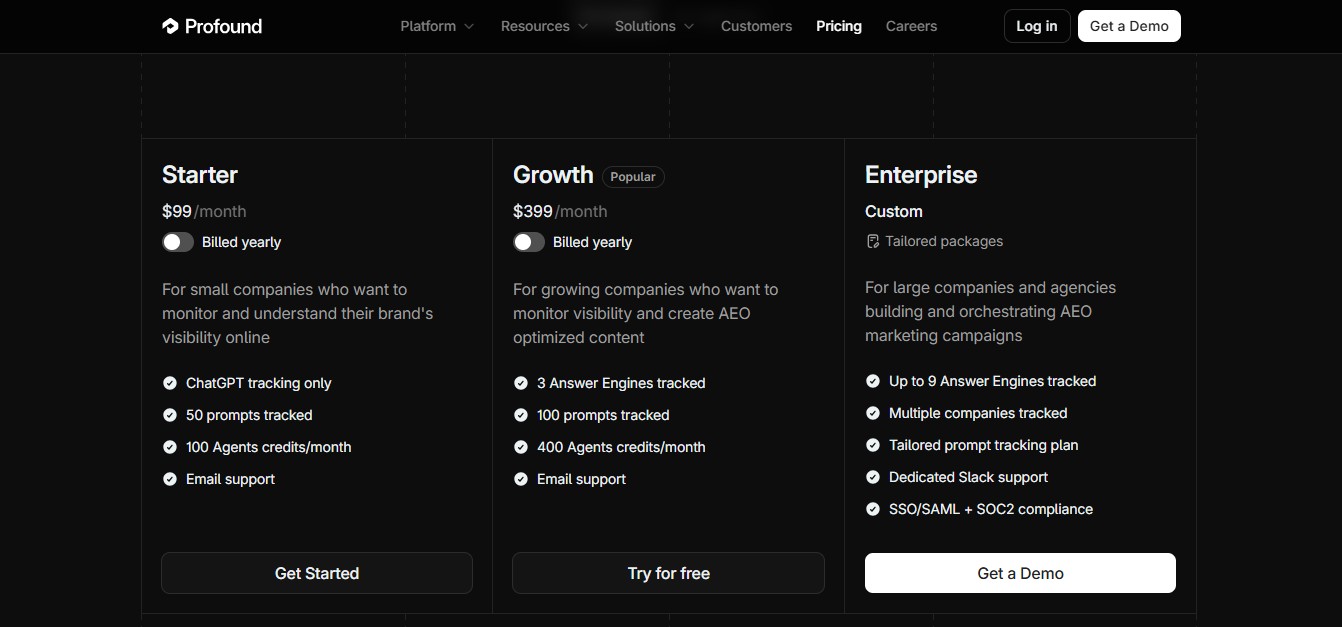
Profound’s current public pricing separates brands and agencies.
| Profound plan | Price | Key limits |
| Starter | $99/month | 50 prompts tracked, ChatGPT only, 100 agents credits/month, Email support |
| Growth | $399/month plus add-ons | 3 answer engines tracked, 100 prompts tracked, 400 agents credits/month, Email support |
| Enterprise | Custom | 9 answer engines tracked, Multiple Companies Tracked, Slack support |
Full client workspaces are listed as a $399 monthly add-on on the Agency Growth plan.
Profound’s price structure makes it suitable for teams that want to test the platform for free or buy a tailored Enterprise or agency package. The lack of a public mid-tier brand plan means smaller teams may need to compare its long-term cost directly with other options.
Otterly pricing
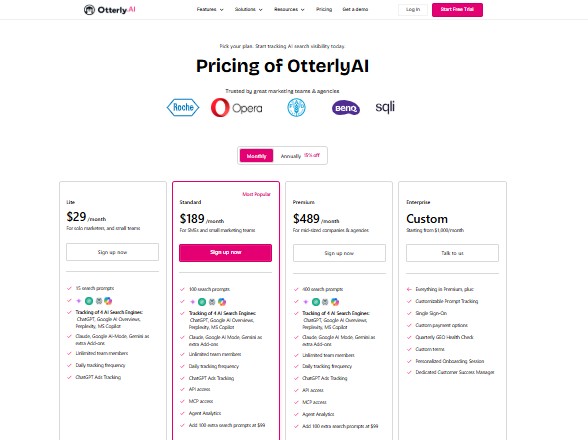
OtterlyAI offers monthly and annual billing. Annual pricing shows a 15% discount.
| OtterlyAI plan | Monthly billing | Annual billing, monthly equivalent | Prompts |
| Lite | $29/month | $25/month | 15 |
| Standard | $189/month | $160/month | 100 |
| Premium | $489/month | $422/month | 400 |
| Enterprise | Starts at $1,000/month | Custom | Custom |
The core engine package includes ChatGPT, Google AI Overviews, Perplexity, and Microsoft Copilot. Google AI Mode, Gemini, and Claude are add-ons.
OtterlyAI has an accessible Lite plan, but teams should estimate engine add-ons before comparing actual monthly costs. Standard and Premium plans add API access, MCP access, Agent Analytics, Looker Studio, and larger audit limits.
Peec AI pricing
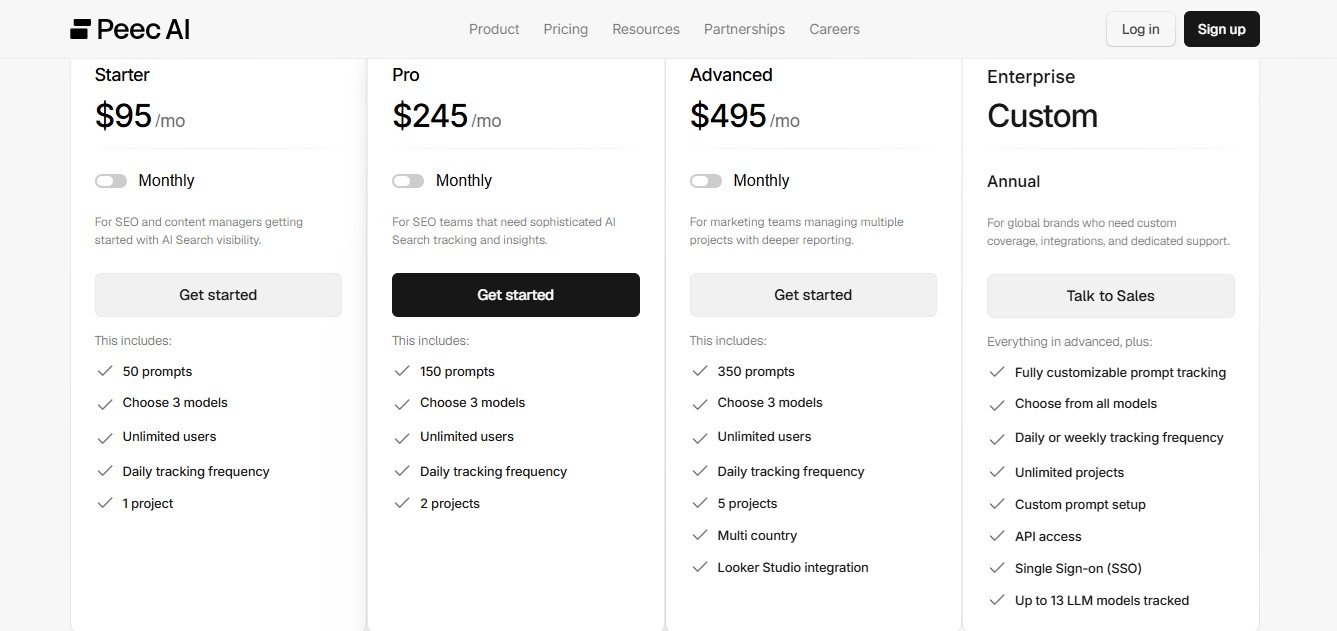
Peec AI’s current monthly pricing is as follows:
| Peec AI plan | Monthly price | Prompts | Models | Projects |
| Starter | $95/month | 50 | Choose 3 | 1 |
| Pro | $245/month | 150 | Choose 3 | 2 |
| Advanced | $495/month | 350 | Choose 3 | 5 |
| Enterprise | Custom, annual | Custom | All models | Unlimited |
All public Peec AI plans include unlimited users and daily tracking. The Advanced plan adds multi-country tracking and Looker Studio integration. Enterprise adds customizable prompt tracking, all models, daily or weekly tracking, unlimited projects, API access, and SSO.
Peec AI is more expensive at entry level than OtterlyAI, but its Starter plan includes 50 prompts and daily tracking. That can make it a good fit for teams that need more initial prompt coverage than OtterlyAI Lite provides.
12. Ease of Use, Support and Scalability
Profound user experience
Profound is designed for teams that want a more complete AI search and marketing environment. This gives larger teams more room for research, agent workflows, content production, reporting, and analytics, but it also means there is more to learn and configure.
The product is likely to deliver the most value when different specialists use it together. SEO teams can monitor prompts and citations, content teams can use briefs and agents, analytics teams can study referral traffic and crawler data, and leadership teams can review broader reporting.
Otterly setup and usability
OtterlyAI is designed to get users from prompt research to monitoring and optimization with a direct workflow. Its product messaging emphasizes setup simplicity, content audits, actionable recommendations, and practical answers to why a site or brand is missing from AI search results.
The Lite plan is approachable for solo marketers and smaller teams. Higher tiers provide larger prompt allowances, workspaces, reporting tools, API access, MCP access, and more audit capacity.
OtterlyAI offers a 7-day free trial without requiring a credit card, which gives teams a chance to test prompt coverage and dashboards before choosing a plan.
Peec AI dashboard experience
Peec AI has one of the clearest dashboard structures for teams that want to focus on a few core metrics. Visibility, position, sentiment, recent chats, sources, competitors, prompt tags, exports, and reports are organized around a straightforward marketing workflow.
This makes Peec AI accessible for teams that want to reduce reporting complexity. It can be especially useful for marketers who want to present AI visibility data to stakeholders without requiring extensive training.
Support options across all three tools
Profound offers dedicated support on Enterprise and specialized support on Agency Enterprise. Its agency plan also lists dedicated agency partnership, go-to-market support, and premium Slack support.
OtterlyAI’s Premium plan includes personal onboarding. Enterprise adds a dedicated Customer Success Manager, personalized onboarding, custom terms, and quarterly GEO Health Checks.
Peec AI offers chat support on Starter, chat and email support on Pro and Advanced, and dedicated support under Enterprise.
Which platform scales best for agencies and enterprises?
Profound is strongest for large enterprise teams and agencies that need AI search intelligence alongside broader agent-led marketing operations. Its agency-specific plans, client workspaces, and enterprise controls make it a serious option for complex organizations.
OtterlyAI scales well for agencies and mid-sized organizations that want more prompts, workspaces, API access, Looker Studio reporting, and customer success support. Peec AI scales cleanly through prompts, projects, countries, languages, reporting, and Enterprise integrations.
Radarkit is particularly appealing for agencies and growing businesses that need a lower-cost operational toolkit. It combines multi-project tracking, client reporting, branded PDFs, AI traffic analytics, local visibility, citation data, competitor research, and agents, with fixed plans from $29 to $139 per month.
Profound vs Otterly vs Peec AI: Feature-by-Feature Winner
| Category | Winner | Why |
| Best for enterprise marketing workflows | Profound | It combines AI search data with agents, briefs, content workflows, context management, crawler data, and analytics |
| Best entry-level price | OtterlyAI and Radarkit | Both start at $29 per month |
| Best entry-level prompt allowance | Peec AI | Starter includes 50 prompts |
| Most extensive potential answer engine coverage | Profound | Enterprise lists support for up to 9 answer engines |
| Best page-level audit workflow | OtterlyAI | Crawlability checks, AI-readiness auditing, Content Audit and Prediction, briefs, and recommendations |
| Clearest core dashboard | Peec AI | Visibility, position, and sentiment are easy to understand and compare |
| Best enterprise citation depth | Profound | Page, passage, source category, crawler, and YouTube citation analysis |
| Best source-driven recommendations | Peec AI | Turns recurring source patterns into content, community, review, and PR actions |
| Best reporting integrations | OtterlyAI and Peec AI | Both offer Looker Studio options and data export workflows |
| Best for small content teams | OtterlyAI | Affordable entry plan plus prompt research and audit features |
| Best for agency workflow depth | Profound | Agency Mode, pitch workspaces, client workspace options, and enterprise agency support |
| Best all-in-one alternative | Radarkit | Combines model tracking, local visibility, citations, content, outreach, reporting, traffic analytics, and agents |
Profound vs Otterly vs Peec AI: Pros and Cons
Profound pros and cons
| Pros | Considerations |
| Supports AI search intelligence and wider marketing workflows | Brand pricing beyond the Trial is custom |
| Enterprise plan can track up to nine answer engines | The free Trial is limited to 10 prompts, one-time tracking, and ChatGPT |
| Includes agents, content briefs, page workflows, research, and reporting | More suitable for teams ready to use a broader platform |
| Offers advanced citation, crawler, and agent analytics | Public pricing is less straightforward for smaller brands |
| Includes dedicated agency offerings | Client workspaces may require an additional agency add-on |
Otterly pros and cons
| Pros | Considerations |
| Starts at $29 per month | Lite has 15 prompts |
| Tracks visibility, citations, competitors, sentiment, and sources | Claude, Google AI Mode, and Gemini require add-ons |
| Includes prompt research, crawlability checks, GEO audits, and content recommendations | Looker Studio, API, MCP, and expanded workspaces start at Standard |
| Supports more than 50 countries | Large prompt programs can move into higher monthly plan ranges |
| Provides a 7-day trial | Total cost depends on required engines and prompt add-ons |
Peec AI pros and cons
| Pros | Considerations |
| Clear focus on visibility, position, and sentiment | Starts at $95 per month |
| Includes 50 prompts on the Starter plan | Public plans include three selected models rather than all models |
| Tracks sources, competitors, prompts, countries, and languages | Looker Studio is listed on the Advanced plan |
| Offers CSV exports, API, MCP, and Looker Studio options | Multiple projects require Pro or Advanced |
| Unlimited users on public plans | Enterprise is needed for all models, unlimited projects, and custom capacity |
Best Alternative to Profound, Otterly and Peec AI
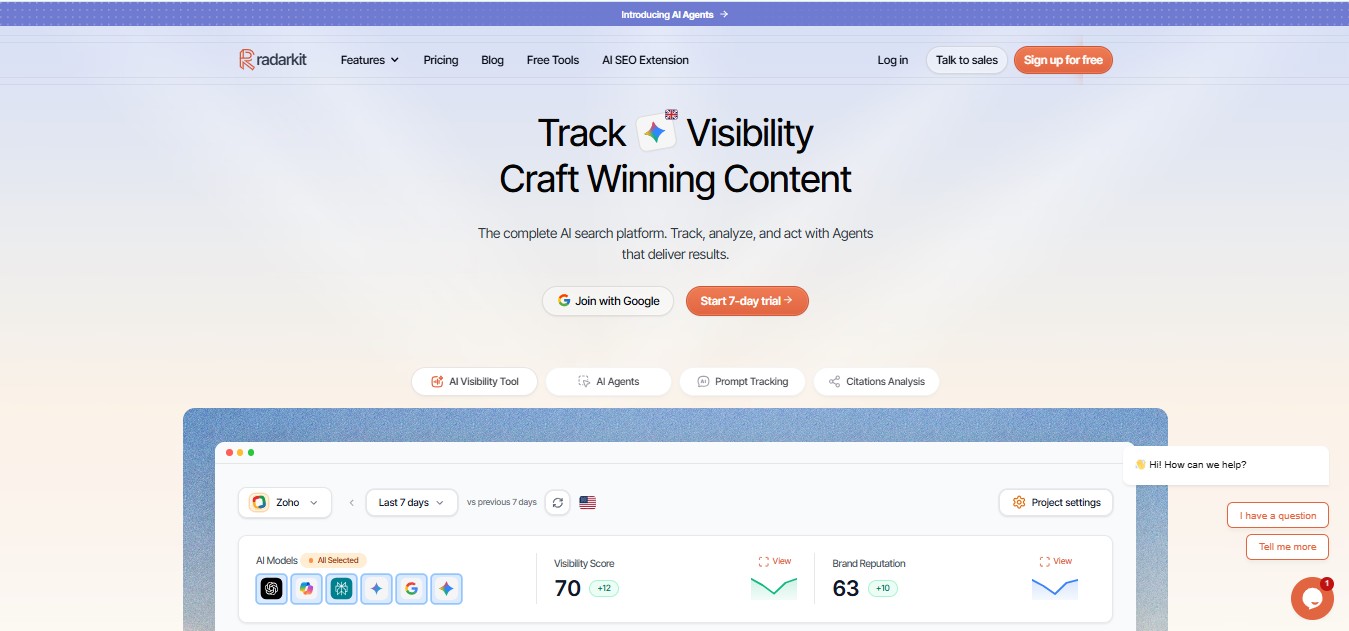
Radarkit is a strong alternative for businesses that want to move from AI search measurement to action without assembling several separate tools. It is built around three connected stages: track visibility, analyze citations and competitors, then act through agents and content workflows.
Radarkit tracks ChatGPT, Google AI Mode, Google AI Overviews, Gemini, Microsoft Copilot, Perplexity, brand visibility, average position, sentiment, citations, citation share, competitors, and query fanout. It uses real chat interfaces rather than APIs for the listed AI platforms.
Its platform is useful for several types of users:
- Brands that want to measure mentions, citations, recommendation position, and AI referral traffic.
- SEO teams that want to find source gaps and content opportunities.
- Agencies that need multiple projects, client-facing reports, and a Client Portal.
- Local businesses and franchises that need location-level AI visibility tracking.
- Content teams that want to turn citation research into articles, page updates, outreach, and community research.
- Marketing teams that need lower fixed pricing than many larger enterprise tools.
Radarkit includes Content, Outreach, Reddit, Chat, and Plan agents. The Content Agent uses Google SERP and AI citation data to support content creation and optimization, while the other agents can help turn data into outreach, community, planning, and research tasks.
Radarkit vs Profound, Otterly and Peec AI
| Feature | Radarkit | Profound | OtterlyAI | Peec AI |
| Starting price | $29/month | Free Trial, then custom for brands | $29/month | $95/month |
| Projects on lowest paid plan | 2 | Agency Growth and Enterprise depend on setup | 1 workspace on Lite | 1 project |
| Prompts on lowest paid plan | 15 | 10 prompts on Trial, one-time | 15 | 50 |
| Daily tracking on lowest paid plan | Lite refreshes every 72 hours | Trial runs once | Yes | Yes |
| AI platforms included on fixed plans | ChatGPT, AI Mode, AI Overviews, Copilot, Gemini, Perplexity | Enterprise package dependent | 4 core engines, extra engines as add-ons | 3 selected models |
| Citation tracking | Yes | Yes | Yes | Yes |
| Citation content-type analysis | Yes | Yes | Yes | Yes |
| Local AI visibility | 50+ countries | Custom Enterprise coverage | 50+ countries | Country and language plans |
| State and city tracking | Enterprise | Custom configuration | Location-level monitoring | Market-level tracking |
| Content tools | Content Agent and WordPress-ready workflows | Agents, briefs, drafts, audits, rewrites | Content audits, prediction, briefs, recommendations | Source-based recommendations |
| Outreach and community tools | Outreach Agent and Reddit Agent | Agent workflows can support outreach | Source insights and recommendations | Source-based action suggestions |
| AI traffic analytics | Yes | Agent Analytics and Google Analytics integration | Agent Analytics on higher plans | Reporting and integrations |
| Client Portal and branded PDFs | Yes | Agency workspaces and custom reporting | Reports and Looker Studio | CSV, Looker Studio, API |
| Best fit | Teams wanting tracking, analysis, content action, local visibility, and reporting together | Enterprise agent-led marketing operations | Content intelligence and AI search optimization | Clean analytics and stakeholder reporting |
Radarkit Lite starts at $29 per month for two projects and 15 prompts, with refreshes every 72 hours. Growth costs $79 per month for five projects and 50 daily-tracked prompts. Pro costs $139 per month for 10 projects and 100 daily-tracked prompts. All fixed plans include the listed AI platform coverage, 50+ locations, AI traffic analytics, agents, MCP and API access, and Google Search Console integration.
Final Verdict
Profound vs Otterly vs Peec AI are all capable AI search visibility platforms, but each works best for a different kind of team.
Choose Profound if your organization needs enterprise-scale AI search intelligence combined with marketing agents, content workflows, detailed citation analysis, crawler data, and agency operations.
Choose OtterlyAI if your priority is AI search monitoring plus practical SEO and content improvements. It is a good fit for teams that want prompt research, page audits, crawlability checks, GEO recommendations, and source analysis at an accessible entry price.
Choose Peec AI if you want a clean reporting-first experience centered on visibility, position, sentiment, competitors, prompts, and citations. It is especially useful for marketing teams that value clear dashboards and structured reporting.
For the best overall alternative for Profound vs Otterly vs Peec AI, Radarkit is the strongest choice for teams that want a complete AI search workflow at a more accessible fixed price. It covers major AI platforms, visibility, competitor analysis, citations, sentiment, local tracking, query fanout, AI traffic analytics, client reporting, and action-oriented agents. Instead of stopping at a dashboard, Radarkit helps teams convert AI search data into content, page improvements, outreach opportunities, Reddit research, and a practical execution plan.
FAQ
What is the main difference between Profound, OtterlyAI, and Peec AI?
Profound is an enterprise-oriented AI search intelligence and marketing agent platform. OtterlyAI focuses on AI search monitoring, prompt research, content audits, crawlability, and GEO optimization. Peec AI focuses on analytics, with visibility, position, sentiment, competitor analysis, and source tracking as its core workflow.
Is Profound better than OtterlyAI?
Profound is better suited to large teams that need broader agent-led marketing workflows and Enterprise-scale customization. OtterlyAI is often more practical for content teams that want prompt monitoring, page audits, citation tracking, and recommendations with public monthly pricing.
Is Peec AI worth it for AI search tracking?
Peec AI can be worth it for teams that want a clear view of visibility, position, sentiment, cited sources, and competitors. Its Starter plan includes 50 prompts, three selected models, unlimited users, daily tracking, and one project for $95 per month.
Which tool has the lowest price?
OtterlyAI Lite and Radarkit Lite both start at $29 per month. OtterlyAI Lite includes 15 prompts and daily tracking across four core engines. Radarkit Lite includes two projects, 15 prompts, six listed AI platforms, 50+ locations, AI traffic analytics, and a 72-hour refresh cycle.
Which platform tracks the most AI search engines?
Profound’s Enterprise plan supports up to nine answer engines. OtterlyAI covers a broad range of engines but charges extra for Claude, Google AI Mode, and Gemini. Peec AI lets users choose three models on public plans and access all models on Enterprise.
Can these tools track AI citations?
Yes. Profound, OtterlyAI, and Peec AI all track citations and sources. Profound provides detailed citation intelligence, including page and passage-level analysis. OtterlyAI connects citation data with crawlability and content audits. Peec AI uses source findings to support strategic recommendations.
Which AI search tool is best for agencies?
Profound is strong for large agencies because of Agency Mode, pitch workspaces, client workspace options, and enterprise support. OtterlyAI and Peec AI offer multi-workspace or multi-project options and reporting integrations. Radarkit is a cost-effective alternative for agencies that need multi-project tracking, a Client Portal, branded PDF reports, local visibility, and action-oriented agents.
Does Radarkit track Google AI Overviews, AI Mode, ChatGPT, Gemini, Perplexity, and Copilot?
Yes. Radarkit lists tracking for Google AI Overviews, Google AI Mode, ChatGPT, Gemini, Perplexity, and Microsoft Copilot. It also includes brand visibility, average position, sentiment, citations, competitor tracking, local visibility, query fanout, and AI traffic analytics.
What is the best alternative to Profound, OtterlyAI, and Peec AI?
Radarkit is the best overall alternative for teams that need broad AI search tracking and execution tools in one platform. It combines major model coverage, citation analysis, local tracking, competitor research, AI traffic monitoring, agents, branded reporting, and client-facing tools at fixed plans starting from $29 per month.
